Series
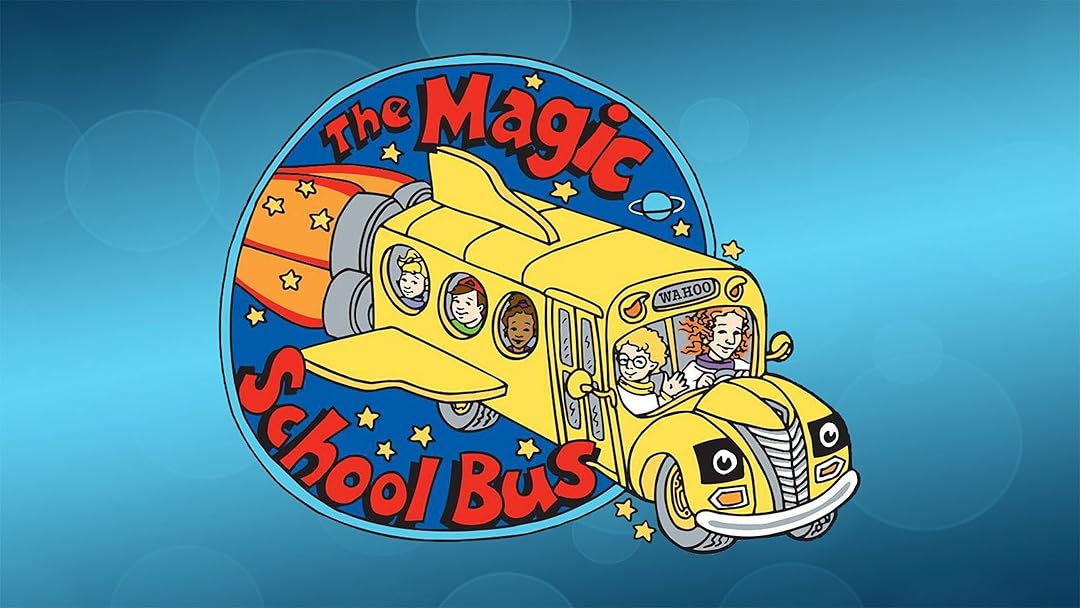
The Magic School Bus
52 episodes
Twenty-six-minute animated episodes in which Ms. Frizzle's bus shrinks, burrows, or launches so the class can see a science idea from the inside. They ride through Arnold's digestive system, shrink into a circuit to find the break, tour the planets after a planetarium trip goes sideways, and stand in a desert Phoebe was sure was empty. Every episode is built the same useful way: a wrong guess, a field trip that tests it, a corrected idea. That makes it a clean model for how investigating actually works. Elementary science across life, earth, physical, and space topics.
What The Magic School Bus covers
52 episodes in the library, tagged for K–6th. Heaviest coverage: Science, Health and Social Studies. Between them they line up with 25 distinct standards across 5 frameworks.
Episodes per grade
- K
- 8
- 1st
- 8
- 2nd
- 50
- 3rd
- 52
- 4th
- 44
- 5th
- 44
- 6th
- 2
Episodes per subject
- Science
- 52
- Health
- 5
- Social Studies
- 3
- Art
- 1
- Technology
- 1
NGSS (Science) 19
- 4-LS1-1Construct an argument that plants and animals have internal and external structures that function to support survival, growth, behavior, and reproduction.
- 4-PS3-2Make observations to provide evidence that energy can be transferred from place to place by sound, light, heat, and electric currents.
- 5-ESS2-1Develop a model using an example to describe ways the geosphere, biosphere, hydrosphere, and/or atmosphere interact.
- 5-LS2-1Develop a model to describe the movement of matter among plants, animals, decomposers, and the environment.
- K-LS1-1Use observations to describe patterns of what plants and animals (including humans) need to survive.
- MS-LS1-3Use argument supported by evidence for how the body is a system of interacting subsystems composed of groups of cells.
+ 13 more
- 5-PS1-3Make observations and measurements to identify materials based on their properties.
- 2-LS2-1Plan and conduct an investigation to determine if plants need sunlight and water to grow.
- 3-PS2-1Plan and conduct an investigation to provide evidence of the effects of balanced and unbalanced forces on the motion of an object.
- MS-ESS1-1Develop and use a model of the Earth-sun-moon system to describe the cyclic patterns of lunar phases, eclipses of the sun and moon, and seasons.
- 1-ESS1-1Use observations of the sun, moon, and stars to describe patterns that can be predicted.
- 3-ESS2-1Represent data in tables and graphical displays to describe typical weather conditions expected during a particular season.
- 3-LS4-1Analyze and interpret data from fossils to provide evidence of the organisms and the environments in which they lived long ago.
- 3-PS2-3Ask questions to determine cause-and-effect relationships of electric or magnetic interactions between two objects not in contact with each other.
- 5-ESS1-2Represent data in graphical displays to reveal patterns of daily changes in length and direction of shadows, day and night, and the seasonal appearance of some stars in the night sky.
- 5-ESS3-1Obtain and combine information about ways individual communities use science ideas to protect the Earth's resources and environment.
- 5-PS1-4Conduct an investigation to determine whether the mixing of two or more substances results in new substances.
- 5-PS2-1Support an argument that the gravitational force exerted by Earth on objects is directed down.
- MS-ESS2-4Develop a model to describe the cycling of water through Earth's systems driven by energy from the sun and the force of gravity.
Social Studies (C3 / NCSS) 1
- D2.His.16.3-5Use evidence to develop a claim about the past.
National Core Arts 1
- VA:Cr2.1.2Experiment with various materials and tools to explore personal interests in a work of art or design.
National Health Education 3
- NHES.1Standard 1: Students comprehend functional health knowledge to enhance health.
- NHES.1.5.5Describe practices and behaviors that prevent or reduce health risks, such as eating vegetables and fruit daily.
- NHES.1.5.6Explain ways to take part in healthy practices and behaviors, such as daily moderate-to-vigorous physical activity.
ISTE (Technology) 1
- ISTE.1.5.dAlgorithmic thinking: put steps in order to solve a problem, and recognize what can be automated.
Every episode is vetted and tagged before it goes in. Pick your state in the filters above to see your own state’s codes alongside these.
24 of 52 results
Gets Lost in Space
The Magic School Bus · 1994
26 min2nd3rd4th5th
For Lunch
The Magic School Bus · 1994
26 min2nd3rd4th5thInside Ralphie
The Magic School Bus · 1994
26 min2nd3rd4th5thGets Eaten
The Magic School Bus · 1994
26 min2nd3rd4th5thHops Home
The Magic School Bus · 1994
26 minK1st2nd3rdMeets the Rot Squad
The Magic School Bus · 1994
26 min2nd3rd4th5thAll Dried Up
The Magic School Bus · 1994
26 min2nd3rd4th5thIn the Haunted House
The Magic School Bus · 1994
26 min2nd3rd4th5thGets Ready, Set, Dough
The Magic School Bus · 1994
26 min2nd3rd4th5thPlays Ball
The Magic School Bus · 1994
26 min2nd3rd4th5thGoes to Seed
The Magic School Bus · 1994
26 minK1st2nd3rdGets Ants in Its Pants
The Magic School Bus · 1994
26 minK1st2nd3rdKicks Up a Storm
The Magic School Bus · 1994
26 min2nd3rd4th5thBlows Its Top
The Magic School Bus · 1995
26 min2nd3rd4th5thFlexes Its Muscles
The Magic School Bus · 1995
26 min2nd3rd4th5thThe Busasaurus
The Magic School Bus · 1995
26 min2nd3rd4th5thGoing Batty
The Magic School Bus · 1995
26 minK1st2nd3rdButterfly and the Bog Beast
The Magic School Bus · 1995
26 minK1st2nd3rdWet All Over
The Magic School Bus · 1995
26 min2nd3rd4th5thIn a Pickle
The Magic School Bus · 1995
26 min2nd3rd4th5thRevving Up
The Magic School Bus · 1995
26 min2nd3rd4th5thTaking Flight
The Magic School Bus · 1995
26 min2nd3rd4th5thGetting Energized
The Magic School Bus · 1995
26 min2nd3rd4th5thOut of This World
The Magic School Bus · 1995
26 min2nd3rd4th5th




Or use the filters above to narrow this down.