Series
Lyla in the Loop
20 episodes
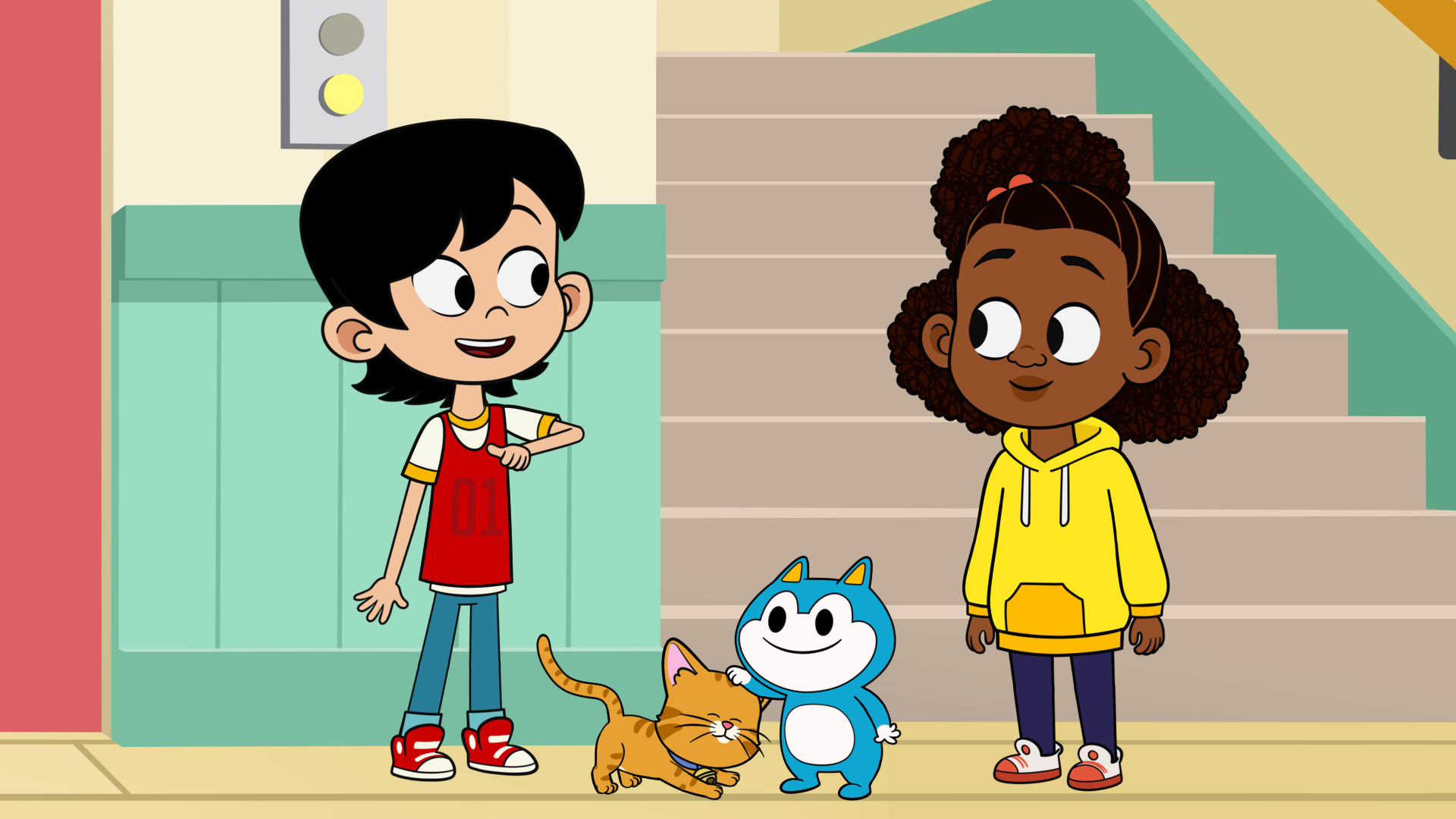
A PBS KIDS series about Lyla Loops, her family, and Stu, the big blue creature only she can see. Each half hour holds two stories, and every story is a problem taken apart in steps: designing a morning routine so the family stops running late, debugging why Stu has started beeping, testing and retesting a homemade cleanup contraption, sequencing a sandwich or a batch of cookies, working out the timing inside a double-dutch rope. It is computational thinking dressed as an ordinary week, where you plan, try, look at what broke, and revise. Pre-K through grade 2.
What Lyla in the Loop covers
20 episodes in the library, tagged for Pre-K–2nd. Heaviest coverage: Social-Emotional Learning, Technology and Reading & Writing (ELA). Between them they line up with 30 distinct standards across 7 frameworks.
Episodes per grade
- Pre-K
- 20
- K
- 20
- 1st
- 20
- 2nd
- 20
Episodes per subject
- Social-Emotional Learning
- 20
- Technology
- 20
- Reading & Writing (ELA)
- 3
- Math
- 3
- Art
- 1
- Science
- 1
- Social Studies
- 1
NGSS (Science) 1
- 2-LS2-1Plan and conduct an investigation to determine if plants need sunlight and water to grow.
Common Core — Math 2
- 2.MD.C.8Solve word problems involving dollar bills, quarters, dimes, nickels, and pennies, using $ and ¢ symbols appropriately.
- 1.OA.C.5Relate counting to addition and subtraction (e.g., by counting on 2 to add 2).
Common Core — ELA 1
- RL.1.2Retell stories, including key details, and demonstrate understanding of their central message or lesson.
Social Studies (C3 / NCSS) 1
- D2.Geo.6.K-2Identify some cultural and environmental characteristics of specific places.
National Core Arts 1
- VA:Cr3.1.5Create artist statements using art vocabulary to describe personal choices in art-making.
CASEL (Social-Emotional) 14
- CASEL.SM.5Use planning and organizational skills to break a task into steps and manage time and materials.
- CASEL.SM.4Set personal and group goals and track progress toward them.
- CASEL.RDM.2Identify solutions to personal and social problems.
- CASEL.RDM.3Make a reasoned judgment after looking at the information, facts, and evidence.
- CASEL.RS.3Practice teamwork and solve problems collaboratively.
- CASEL.SA.6Hold a growth mindset: treat effort, practice, and mistakes as how ability grows.
+ 8 more
- CASEL.SM.3Show self-discipline and self-motivation — keep working when a task gets hard or boring.
- CASEL.RDM.4Anticipate and evaluate the consequences of your actions before you act.
- CASEL.RS.2Build and keep positive relationships and friendships.
- CASEL.RS.6Show leadership in a group — organize, include, and share the work.
- CASEL.RS.9Show respect and cultural competency across differences in background, language, and ability.
- CASEL.SA.3Recognize your own strengths, interests, and the assets you bring from your family and culture.
- CASEL.SOA.1Take another person's perspective — describe a situation as they would see it.
- CASEL.SOA.6Identify the different rules and norms groups follow, including ones that are unfair.
ISTE (Technology) 10
- ISTE.1.5.dAlgorithmic thinking: put steps in order to solve a problem, and recognize what can be automated.
- ISTE.1.5.aProblem definitions: state a problem in a way that data analysis or an algorithm could help solve.
- ISTE.1.4.aDesign process: follow a deliberate design process to generate ideas and possible solutions.
- ISTE.1.4.cPrototypes: build, test, and improve prototypes through cycles of revision.
- ISTE.1.5.cDecompose problems: break a complex system or task into smaller parts.
- ISTE.1.1.cFeedback to improve practice: seek feedback through technology and show learning in more than one way.
+ 4 more
- ISTE.1.3.cCurate information: collect and organize digital resources so the connections between them are clear.
- ISTE.1.4.dOpen-ended problems: stick with problems that have no single right answer.
- ISTE.1.6.dCustomize the message: shape and publish work for a particular audience.
- ISTE.1.7.cProject teams: take on a role and contribute constructively toward a shared goal.
Every episode is vetted and tagged before it goes in. Pick your state in the filters above to see your own state’s codes alongside these.
20 results
Lyla Can't Sleep / Hairdos and Hair Don'ts
Lyla in the Loop · 2025
25 minPre-KK1st2nd

Piece of Cake/Kibbles and Coins
Lyla in the Loop · 2024
24 minPre-KK1st2ndThe Mystery Puzzle/The Stu Express
Lyla in the Loop · 2024
24 minPre-KK1st2ndEvery Sand-Which Way/Growing Up
Lyla in the Loop · 2024
24 minPre-KK1st2ndCarnival for Luke/Rap Report
Lyla in the Loop · 2024
24 minPre-KK1st2ndLemonade Champs/Double Dutch Dilemma
Lyla in the Loop · 2024
24 minPre-KK1st2ndThe Waffle Man/Loopa-palooza
Lyla in the Loop · 2024
24 minPre-KK1st2ndHow to Hamster/A Bad Case of the Beeps
Lyla in the Loop · 2024
24 minPre-KK1st2ndOperation: Rise and Shine/The Carrot Cake Dance
Lyla in the Loop · 2024
24 minPre-KK1st2ndLoopstastic Mess Vacuum Test/How the Cookie Crumbled
Lyla in the Loop · 2024
24 minPre-KK1st2ndThe Case of the Mysterious Cake/Kibbles and Tricks
Lyla in the Loop · 2024
24 minPre-KK1st2ndWhen Luke Became Stu/Secret Surprise Party
Lyla in the Loop · 2024
24 minPre-KK1st2ndStu's Up/Roll n' Scoot
Lyla in the Loop · 2024
24 minPre-KK1st2nd2 on 2 Plus Stu/The Stu-Mobile
Lyla in the Loop · 2024
24 minPre-KK1st2ndToo Many Pumpkins/The Maybe-Sitters
Lyla in the Loop · 2024
24 minPre-KK1st2ndHappy New Year, Lyla!/Everett's Summer Sale
Lyla in the Loop · 2024
24 minPre-KK1st2ndLyla Gets a Grip/Rappin' Riddles
Lyla in the Loop · 2025
24 minPre-KK1st2ndThe Artist Formerly Known as Liana/Jamaica Day
Lyla in the Loop · 2025
24 minPre-KK1st2ndHappy Stu Day/Judge Lyla
Lyla in the Loop · 2025
24 minPre-KK1st2ndWhen We Met Stu
Lyla in the Loop · 2025
24 minPre-KK1st2nd