Series
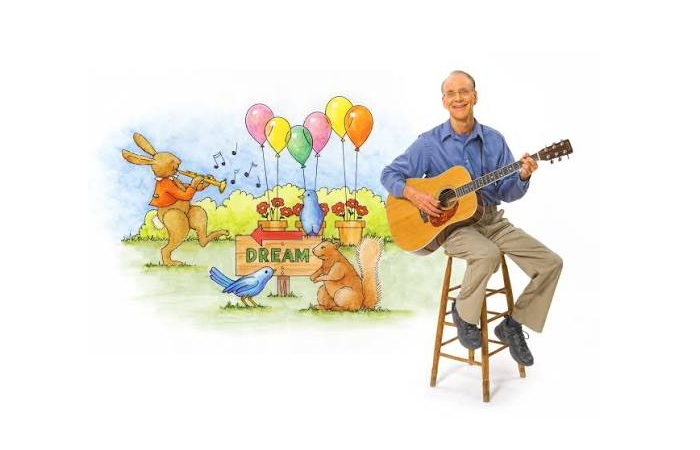
Hap Palmer
118 episodes
The catalog of a children's-music songwriter whose recordings have lived in early-childhood classrooms for decades, gathered here as tracks of two to four minutes. Three strands: early arithmetic from his Count, Add, Subtract collection, where children add and take away within ten in time with the music; alphabet and letter-sound songs, often with movement or a bean bag folded in; and plain silly sing-alongs such as Backwards Land and Amanda Schlupp. Because movement is baked into most of it, a track doubles as a transition. Strongest in pre-K through second grade, where the counting and letter songs do real work.
What Hap Palmer covers
118 episodes in the library, tagged for Pre-K–4th. Heaviest coverage: For Fun, Brain Breaks and Dance. Between them they line up with 31 distinct standards across 4 frameworks.
Episodes per grade
- Pre-K
- 105
- K
- 114
- 1st
- 105
- 2nd
- 41
- 3rd
- 3
- 4th
- 3
Episodes per subject
- For Fun
- 55
- Brain Breaks
- 24
- Dance
- 24
- Math
- 17
- Reading & Writing (ELA)
- 9
- Social-Emotional Learning
- 9
- Music
- 5
Common Core — Math 9
- K.CC.A.1Count to 100 by ones and by tens.
- K.CC.B.5Count to answer "how many?" questions about as many as 20 things arranged in a line, array, or circle, or as many as 10 things in a scattered configuration.
- K.OA.A.1Represent addition and subtraction with objects, fingers, mental images, drawings, sounds, acting out situations, verbal explanations, expressions, or equations.
- K.OA.A.2Solve addition and subtraction word problems, and add and subtract within 10, using objects or drawings to represent the problem.
- 3.OA.A.1Interpret products of whole numbers, e.g., interpret 5 × 7 as the total number of objects in 5 groups of 7 objects each.
- 3.OA.C.7Fluently multiply and divide within 100. By the end of Grade 3, know from memory all products of two one-digit numbers.
+ 3 more
- K.G.A.1Describe objects in the environment using names of shapes, and describe the relative positions of these objects using terms such as above, below, beside, in front of, behind, and next to.
- K.G.A.2Correctly name shapes regardless of their orientations or overall size.
- 2.MD.C.8Solve word problems involving dollar bills, quarters, dimes, nickels, and pennies, using $ and ¢ symbols appropriately.
Common Core — ELA 4
- RF.K.3Know and apply grade-level phonics and word analysis skills in decoding words.
- RF.K.2Demonstrate understanding of spoken words, syllables, and sounds (phonemes).
- RF.K.1Demonstrate understanding of the organization and basic features of print.
- RF.K.4Read emergent-reader texts with purpose and understanding.
National Core Arts 7
- DA:Cr1.1.KaRespond in movement to a variety of stimuli (for example, music/sound, text, objects, images, symbols, observed dance).
- DA:Pr5.1.KbMove safely in general space and start and stop on cue during activities, group formations, and creative explorations while maintaining personal space.
- DA:Cr1.1.1aExplore movement inspired by a variety of stimuli (for example, music/sound, text, objects, images, symbols, observed dance, experiences) and identify the source.
- DA:Pr5.1.KaDemonstrate same-side and cross-body locomotor and non-locomotor movements, body patterning movements, and body shapes.
- MU:Pr4.2.KaWith guidance, explore and demonstrate awareness of music contrasts (such as high/low, loud/soft, same/different) in a variety of music selected for performance.
- MU:Cr1.1.KaWith guidance, explore and experience music concepts such as beat and melodic contour.
+ 1 more
- MU:Pr4.3.KaWith guidance, demonstrate awareness of expressive qualities (such as voice quality, dynamics, and tempo) that support the creators’ expressive intent.
CASEL (Social-Emotional) 11
- CASEL.SA.6Hold a growth mindset: treat effort, practice, and mistakes as how ability grows.
- CASEL.SA.3Recognize your own strengths, interests, and the assets you bring from your family and culture.
- CASEL.SM.2Use calming and stress-management strategies (deep breaths, a break, asking for space).
- CASEL.RS.3Practice teamwork and solve problems collaboratively.
- CASEL.RS.9Show respect and cultural competency across differences in background, language, and ability.
- CASEL.SA.1Name your own feelings and notice how they change during the day.
+ 5 more
- CASEL.SA.5Show self-confidence — believe you can do hard things and take on a challenge.
- CASEL.SM.1Manage strong emotions and impulses instead of acting on them right away.
- CASEL.SOA.2Demonstrate empathy and compassion for others.
- CASEL.SOA.3Show concern for other people's feelings and respond to them with care.
- CASEL.SOA.5Understand and express gratitude.
Every episode is vetted and tagged before it goes in. Pick your state in the filters above to see your own state’s codes alongside these.
24 of 118 results
Bluegrass Jamboree
Hap Palmer
2 minPre-KK1st2nd
Bop 'Til We Drop
Hap Palmer
4 minPre-KK1st2ndEverybody Dance
Hap Palmer
3 minPre-KK1st2ndHead, Shoulders, Knees and Toes (Hap Palmer)
Hap Palmer
2 minPre-KK1st2ndOpen Shut Them
Hap Palmer
3 minPre-KK1st2ndPercival the Parrot
Hap Palmer
4 minPre-KK1st2ndRock and Roll Freeze Dance
Hap Palmer
2 minPre-KK1st2ndShake Something
Hap Palmer
3 minPre-KK1st2ndWeekly Rap
Hap Palmer
3 minPre-KK1st2ndPut Your Hands Up in the Air
Hap Palmer
2 minPre-KK1st2ndWiggy Wiggles
Hap Palmer
2 minPre-KK1st2ndTouch Your Toes to Your Nose
Hap Palmer
2 minPre-KK1st2ndI'm a Pretzel
Hap Palmer
2 minPre-KK1st2ndBounce!
Hap Palmer
3 minPre-KK1st2ndBeanbag Shake
Hap Palmer
2 minPre-KK1st2ndLet's All Clap Our Hands Together
Hap Palmer
3 minPre-KK1st2ndScamper
Hap Palmer
1 minPre-KK1st2ndSammy
Hap Palmer
3 minPre-KK1st2ndWalking
Hap Palmer
2 minPre-KK1st2ndColors in Motion
Hap Palmer
3 minPre-KK1st2ndParade of Colors
Hap Palmer
3 minPre-KK1st2ndJig Along Shapes
Hap Palmer
2 minPre-KK1st2ndMonths on the Move
Hap Palmer
3 minPre-KK1st2ndWhen I'm Down I Get Up and Dance
Hap Palmer
2 minPre-KK1st2nd






Or use the filters above to narrow this down.