Series
The Prime Radicals
18 episodes
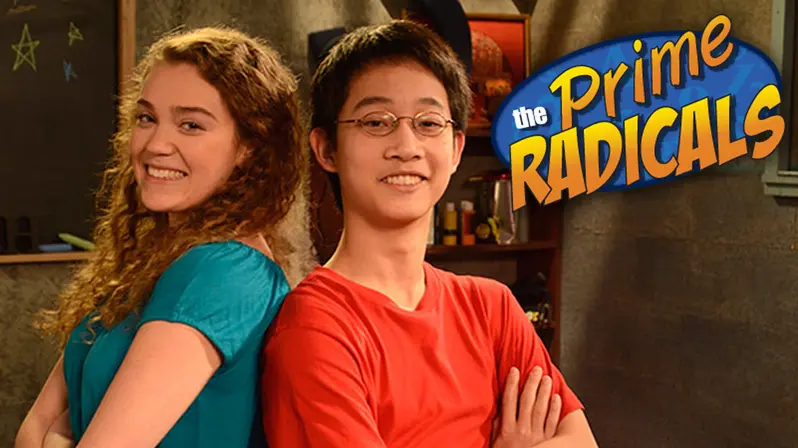
The Prime Radicals is a Canadian math show where Uncle Norm and a crew of sharp kids called the Rads chase down everyday number problems. Season 1 runs as fifteen-minute stories: a wobbly stack of golf balls becomes a lesson on patterns, a mix-up over cubic metres of soil turns into measuring volume, and a broken teeter-totter teaches balance. Season 2 boils each idea into a short, catchy math song about fractions, telling time, capacity, magic squares, and more. Reach for it in grades 1 through 5 when you want a real-world hook before math or a quick sing-along warm-up. Every clip streams free on YouTube.
What The Prime Radicals covers
18 episodes in the library, tagged for 1st–5th. Heaviest coverage: Math. Between them they line up with 15 distinct standards across 1 framework.
Episodes per grade
- 1st
- 5
- 2nd
- 9
- 3rd
- 14
- 4th
- 11
- 5th
- 2
Episodes per subject
- Math
- 18
Common Core — Math 15
- 3.OA.D.9Identify arithmetic patterns (including patterns in the addition table or multiplication table), and explain them using properties of operations.
- 2.G.A.3Partition circles and rectangles into two, three, or four equal shares; describe the shares using the words halves, thirds, half of, a third of, etc.
- 2.NBT.A.2Count within 1000; skip-count by 5s, 10s, and 100s.
- 3.NF.A.1Understand a fraction 1/b as the quantity formed by 1 part when a whole is partitioned into b equal parts; understand a fraction a/b as the quantity formed by a parts of size 1/b.
- 4.OA.C.5Generate a number or shape pattern that follows a given rule; identify apparent features of the pattern that were not explicit in the rule itself.
- 1.NBT.A.1Count to 120, starting at any number less than 120. Read and write numerals and represent a number of objects with a written numeral.
+ 9 more
- 2.G.A.1Recognize and draw shapes having specified attributes, such as a given number of angles or a given number of equal faces; identify triangles, quadrilaterals, pentagons, hexagons, and cubes.
- 2.MD.A.3Estimate lengths using units of inches, feet, centimeters, and meters.
- 2.MD.C.7Tell and write time from analog and digital clocks to the nearest five minutes, using a.m. and p.m.
- 3.MD.A.2Measure and estimate liquid volumes and masses of objects using standard units of grams, kilograms, and liters; solve one-step problems involving these quantities.
- 3.OA.A.1Interpret products of whole numbers, e.g., interpret 5 × 7 as the total number of objects in 5 groups of 7 objects each.
- 4.G.A.3Recognize a line of symmetry for a two-dimensional figure; identify line-symmetric figures and draw lines of symmetry.
- 5.MD.C.3Recognize volume as an attribute of solid figures and understand concepts of volume measurement using unit cubes.
- 5.MD.C.4Measure volumes by counting unit cubes, using cubic cm, cubic in, cubic ft, and improvised units.
- 5.NF.B.5Interpret multiplication as scaling (resizing) by comparing the size of a product to the size of one factor.
Every episode is vetted and tagged before it goes in. Pick your state in the filters above to see your own state’s codes alongside these.
18 results
The Cubic Rube
The Prime Radicals · 2012
15 min4th5th
How Things Stack Up and Down
The Prime Radicals · 2012
15 min3rd4thThinking About Linking
The Prime Radicals · 2012
15 min2nd3rd4thRule of Thumb
The Prime Radicals · 2012
15 min3rd4thLeader of the Pack
The Prime Radicals · 2012
15 min3rd4thA Balancing Act
The Prime Radicals · 2012
15 min3rd4thCapacity
The Prime Radicals · 2014
2 min2nd3rdCount Up
The Prime Radicals · 2014
2 min1st2ndGet in on the Fraction Action
The Prime Radicals · 2014
1 min2nd3rdTime and Again
The Prime Radicals · 2014
3 min1st2ndMathemagic
The Prime Radicals · 2014
2 min3rd4thOnce Upon Five Minutes of Time
The Prime Radicals · 2014
1 min1st2nd3rdTaking Your Temperature
The Prime Radicals · 2014
1 min1st2nd3rdScale Me Up
The Prime Radicals · 2014
2 min4th5thAn Equal Share Is Fair
The Prime Radicals · 2014
1 min1st2nd3rdCracking the Code
The Prime Radicals · 2014
2 min3rd4thThere's Magic in Those Squares
The Prime Radicals · 2014
1 min2nd3rd4thWhat Are the Chances
The Prime Radicals · 2014
2 min3rd4th


