Series
Secret Millionaires Club
26 episodes
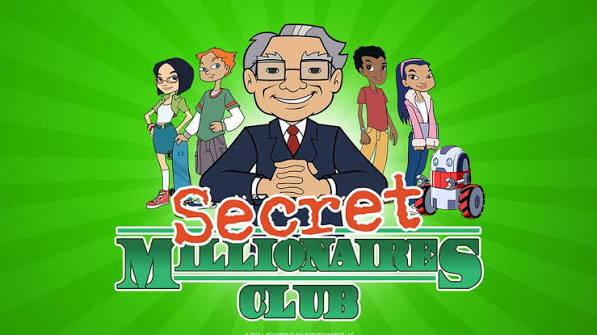
An animated series in which a kids' club runs small businesses with investor Warren Buffett appearing as their mentor. Each 22-minute episode wraps one money idea in a story: a gift shop that tries to sell everything and loses focus, a three-part trip to King Arthur's court that works through spending, debt and repayment, a microloan that gets somebody started, a negotiation that has to be fair on both sides. A few reach further, into copyright and pirated downloads or into how trade connects countries. Written for grades 3-6 and easy to slot into economics work.
What Secret Millionaires Club covers
26 episodes in the library, tagged for 3rd–6th. Heaviest coverage: Social Studies, Social-Emotional Learning and Technology. Between them they line up with 20 distinct standards across 4 frameworks.
Episodes per grade
- 3rd
- 26
- 4th
- 26
- 5th
- 26
- 6th
- 26
Episodes per subject
- Social Studies
- 26
- Social-Emotional Learning
- 7
- Technology
- 1
Social Studies (C3 / NCSS) 11
- D2.Eco.1.3-5Compare the benefits and costs of individual choices.
- D2.Eco.2.3-5Identify positive and negative incentives that influence the decisions people make.
- D2.Eco.7.3-5Explain how profits influence sellers in markets.
- D2.Eco.10.3-5Explain what interest rates are.
- D2.Eco.3.3-5Identify examples of the variety of resources (human capital, physical capital, and natural resources) that are used to produce goods and services.
- D2.Eco.6.3-5Explain the relationship between investment in human capital, productivity, and future incomes.
+ 5 more
- D2.Eco.9.3-5Describe the role of other financial institutions in an economy.
- D2.Eco.13.3-5Describe ways people can increase productivity by using improved capital goods and improving their human capital.
- D2.Eco.14.3-5Explain how trade leads to increasing economic interdependence among nations.
- D2.Eco.4.3-5Explain why individuals and businesses specialize and trade.
- D2.Eco.8.3-5Identify examples of external benefits and costs.
CASEL (Social-Emotional) 6
- CASEL.SM.5Use planning and organizational skills to break a task into steps and manage time and materials.
- CASEL.RDM.6Reflect on your role in the well-being of your family, classroom, and community.
- CASEL.RS.3Practice teamwork and solve problems collaboratively.
- CASEL.RS.4Resolve conflicts constructively — talk it out, repair, compromise.
- CASEL.SA.5Show self-confidence — believe you can do hard things and take on a challenge.
- CASEL.SA.6Hold a growth mindset: treat effort, practice, and mistakes as how ability grows.
ISTE (Technology) 1
- ISTE.1.2.aDigital footprint: manage your digital identity and make safe, legal, and ethical choices online.
CSTA (Computer Science) 2
- 1B-AP-14Observe intellectual property rights and give appropriate attribution when creating or remixing programs.
- 1B-IC-21Use public domain or creative commons media, and refrain from copying or using material created by others without permission.
Every episode is vetted and tagged before it goes in. Pick your state in the filters above to see your own state’s codes alongside these.
26 results
Be Cool to Your School
Secret Millionaires Club · 2013
22 min3rd4th5th6th
Neither a Borrower Nor a Lender Be, Dude
Secret Millionaires Club · 2013
22 min3rd4th5th6thWhen Pigs Fly (Secret Millionaires Club)
Secret Millionaires Club · 2013
22 min3rd4th5th6thThe Cost of Giving
Secret Millionaires Club · 2013
22 min3rd4th5th6thElena's Shaqtastic Adventure
Secret Millionaires Club · 2013
22 min3rd4th5th6thAvast Ye Downloads!
Secret Millionaires Club · 2013
22 min3rd4th5th6thDown and Out in Beijing
Secret Millionaires Club · 2013
22 min3rd4th5th6thListen to the Music
Secret Millionaires Club · 2013
22 min3rd4th5th6thParanormally, We Don't Do This Kind of Thing
Secret Millionaires Club · 2013
22 min3rd4th5th6thA Gift Shop Too Far
Secret Millionaires Club · 2013
22 min3rd4th5th6thFinal Financial Frontier
Secret Millionaires Club · 2013
22 min3rd4th5th6thA Midwestern Yankee in King Arthur's Court, Part 1
Secret Millionaires Club · 2013
22 min3rd4th5th6thA Midwestern Yankee in King Arthur's Court, Part 2
Secret Millionaires Club · 2013
22 min3rd4th5th6thA Midwestern Yankee in King Arthur's Court, Part 3
Secret Millionaires Club · 2013
22 min3rd4th5th6thSweeeeet
Secret Millionaires Club · 2013
22 min3rd4th5th6thJust Say Snow
Secret Millionaires Club · 2013
22 min3rd4th5th6thTo Herring is Human
Secret Millionaires Club · 2013
22 min3rd4th5th6thGoooooal!
Secret Millionaires Club · 2013
22 min3rd4th5th6thGet a Clue, Dude
Secret Millionaires Club · 2013
22 min3rd4th5th6thThe Fashion Bot Fiasco
Secret Millionaires Club · 2013
22 min3rd4th5th6thSing Between the Lines
Secret Millionaires Club · 2013
22 min3rd4th5th6thThe Gift (with Bill Gates)
Secret Millionaires Club · 2013
22 min3rd4th5th6thFar Out Future
Secret Millionaires Club · 2013
22 min3rd4th5th6thFor Pete's Pets Sake
Secret Millionaires Club · 2013
22 min3rd4th5th6thBig Things Come in Micro Packages
Secret Millionaires Club · 2013
22 min3rd4th5th6thCamp Bigfoot
Secret Millionaires Club · 2013
22 min3rd4th5th6th