Series
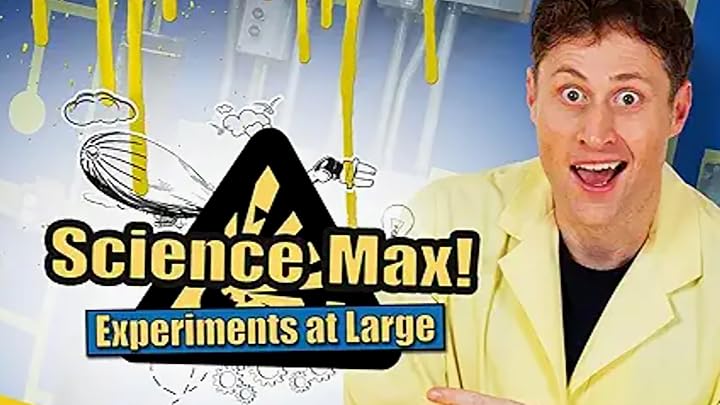
Science Max: Experiments at Large
25 episodes
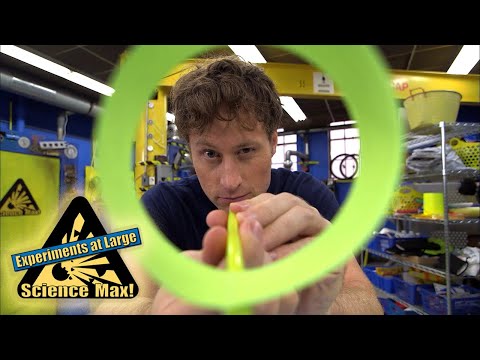
Host Phil runs a science demonstration at classroom scale, then, as the title promises, maxes it out. A folded paper airplane becomes a glider big enough to ride in; a dry-pasta bridge becomes a huge one; a small drag racer becomes a rocket-powered car. Every 22-minute episode holds to one idea: friction, air pressure, elastic energy, static electricity, balance, electromagnets, simple machines, generating electricity. The oversized rebuild is what makes the physics visible, and it gives a class something to argue about before anyone touches a worksheet. Free on the show's official YouTube channel. Grades 2-6.
What Science Max: Experiments at Large covers
25 episodes in the library, tagged for 2nd–6th. Heaviest coverage: Science. Between them they line up with 16 distinct standards across 1 framework.
Episodes per grade
- 2nd
- 8
- 3rd
- 25
- 4th
- 25
- 5th
- 25
- 6th
- 25
Episodes per subject
- Science
- 25
NGSS (Science) 16
- 3-PS2-1Plan and conduct an investigation to provide evidence of the effects of balanced and unbalanced forces on the motion of an object.
- 4-PS3-4Apply scientific ideas to design, test, and refine a device that converts energy from one form to another.
- 4-PS3-2Make observations to provide evidence that energy can be transferred from place to place by sound, light, heat, and electric currents.
- 3-PS2-3Ask questions to determine cause-and-effect relationships of electric or magnetic interactions between two objects not in contact with each other.
- 4-PS3-1Use evidence to construct an explanation relating the speed of an object to the energy of that object.
- 1-PS4-1Plan and conduct investigations to provide evidence that vibrating materials can make sound and that sound can make materials vibrate.
+ 10 more
- 1-PS4-3Plan and conduct an investigation to determine the effect of placing objects made with different materials in the path of a beam of light.
- 2-PS1-1Plan and conduct an investigation to describe and classify different kinds of materials by their observable properties.
- 2-PS1-4Construct an argument with evidence that some changes caused by heating or cooling can be reversed and some cannot.
- 3-PS2-4Define a simple design problem that can be solved by applying scientific ideas about magnets.
- 4-PS4-1Develop a model of waves to describe patterns in terms of amplitude and wavelength and that waves can cause objects to move.
- 4-PS4-2Develop a model to describe that light reflecting from objects and entering the eye allows objects to be seen.
- 5-PS1-1Develop a model to describe that matter is made of particles too small to be seen.
- 5-PS1-3Make observations and measurements to identify materials based on their properties.
- 5-PS1-4Conduct an investigation to determine whether the mixing of two or more substances results in new substances.
- 5-PS2-1Support an argument that the gravitational force exerted by Earth on objects is directed down.
Every episode is vetted and tagged before it goes in. Pick your state in the filters above to see your own state’s codes alongside these.
24 of 25 results
Drag Racer
Science Max: Experiments at Large · 2015
22 min3rd4th5th6th
All About Balance
Science Max: Experiments at Large · 2015
22 min2nd3rd4th5th6thPaper Airplane
Science Max: Experiments at Large · 2015
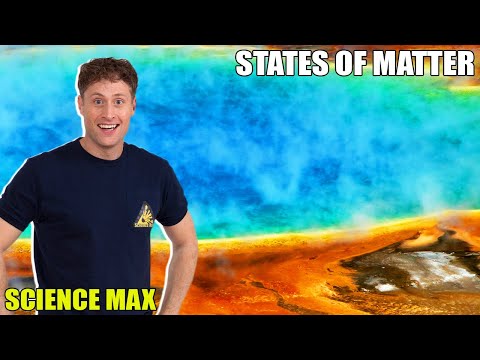
22 min2nd3rd4th5th6thStates of Matter (Science Max)
Science Max: Experiments at Large · 2015
22 min2nd3rd4th5th6thSimple Machines (Science Max)
Science Max: Experiments at Large · 2015
22 min2nd3rd4th5th6thAir Pressure
Science Max: Experiments at Large · 2015
22 min3rd4th5th6thChemistry
Science Max: Experiments at Large · 2015
22 min3rd4th5th6thTinfoil Boat
Science Max: Experiments at Large · 2015
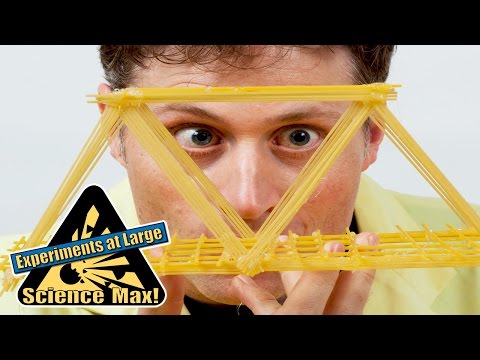
22 min3rd4th5th6thPasta Bridge
Science Max: Experiments at Large · 2015
22 min3rd4th5th6thRocket Car
Science Max: Experiments at Large · 2015
22 min3rd4th5th6thElastic Energy
Science Max: Experiments at Large · 2015
22 min3rd4th5th6thFriction (Science Max)
Science Max: Experiments at Large · 2015
22 min3rd4th5th6thLight Challenge
Science Max: Experiments at Large · 2018
22 min2nd3rd4th5th6thSugar Cube Bridge
Science Max: Experiments at Large · 2018
22 min3rd4th5th6thLightning
Science Max: Experiments at Large · 2018
22 min3rd4th5th6thWater Car
Science Max: Experiments at Large · 2018
22 min3rd4th5th6thStomp Rocket
Science Max: Experiments at Large · 2018
22 min2nd3rd4th5th6thSpool Racer
Science Max: Experiments at Large · 2018
22 min3rd4th5th6thHot Air Balloon
Science Max: Experiments at Large · 2018
22 min3rd4th5th6thVibrobot
Science Max: Experiments at Large · 2018
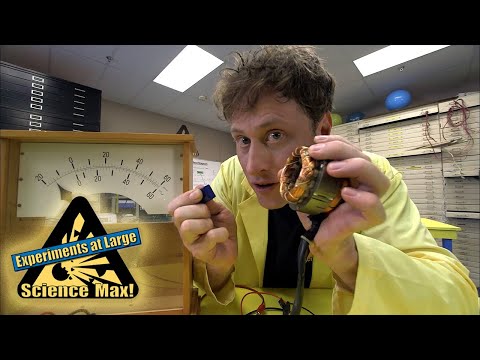
22 min3rd4th5th6thElectromagnet
Science Max: Experiments at Large · 2018
22 min3rd4th5th6thGenerating Electricity
Science Max: Experiments at Large · 2018
22 min3rd4th5th6thHoop Glider
Science Max: Experiments at Large · 2018
22 min2nd3rd4th5th6thLoudest Sound
Science Max: Experiments at Large · 2018
22 min2nd3rd4th5th6th







Or use the filters above to narrow this down.