Series
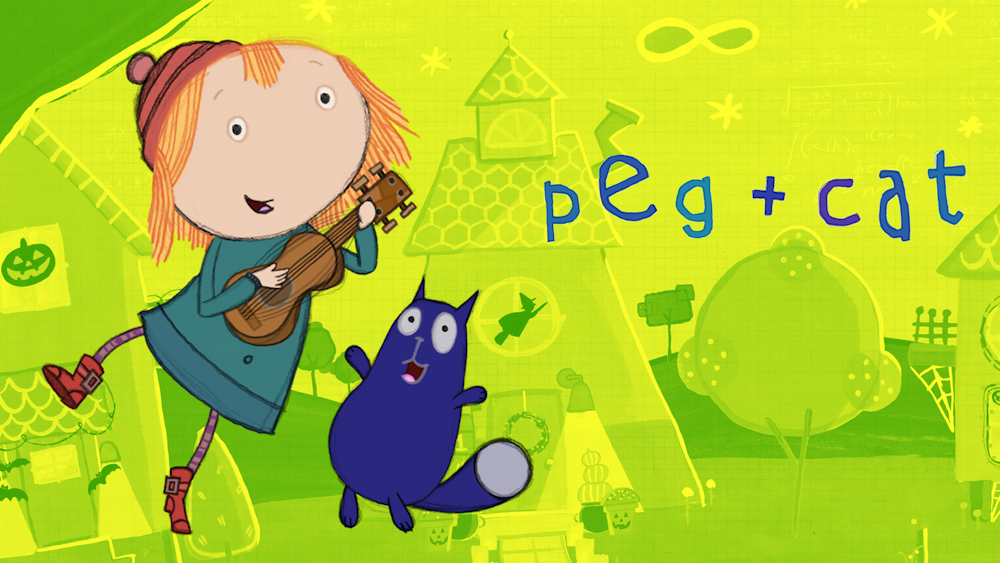
Peg + Cat
31 episodes
Peg has a problem, Cat comes along, and the math is what gets them out. A hundred chickens escape and have to be counted back in; buried treasure gets found by pacing out distances in Cat-lengths; a showdown at high noon stalls because nobody can read a clock. The 31 entries here cover counting to 100, comparing, symmetry, fractions, 2D versus 3D shapes, patterns, and time, usually inside a story with a song in it. Two are quieter, with the math dialed down: how Peg got Cat, and a Broadway musical for Ramone.
What Peg + Cat covers
31 episodes in the library, tagged for Pre-K–2nd. Heaviest coverage: Math, Social-Emotional Learning and Music. Between them they line up with 31 distinct standards across 3 frameworks.
Episodes per grade
- Pre-K
- 10
- K
- 30
- 1st
- 31
- 2nd
- 12
Episodes per subject
- Math
- 31
- Social-Emotional Learning
- 3
- Music
- 2
Common Core — Math 25
- K.CC.A.1Count to 100 by ones and by tens.
- K.CC.A.2Count forward beginning from a given number within the known sequence (instead of having to begin at 1).
- K.CC.B.5Count to answer "how many?" questions about as many as 20 things arranged in a line, array, or circle, or as many as 10 things in a scattered configuration.
- K.G.A.1Describe objects in the environment using names of shapes, and describe the relative positions of these objects using terms such as above, below, beside, in front of, behind, and next to.
- K.CC.C.6Identify whether the number of objects in one group is greater than, less than, or equal to the number of objects in another group.
- K.G.B.4Analyze and compare two- and three-dimensional shapes, in different sizes and orientations, using informal language to describe their similarities, differences, and parts.
+ 19 more
- K.MD.A.1Describe measurable attributes of objects, such as length or weight; describe several measurable attributes of a single object.
- K.MD.A.2Directly compare two objects with a measurable attribute in common, to see which object has "more of"/"less of" the attribute.
- K.OA.A.1Represent addition and subtraction with objects, fingers, mental images, drawings, sounds, acting out situations, verbal explanations, expressions, or equations.
- 1.G.A.1Distinguish between defining attributes versus non-defining attributes; build and draw shapes to possess defining attributes.
- K.CC.C.7Compare two numbers between 1 and 10 presented as written numerals.
- K.G.A.3Identify shapes as two-dimensional (lying in a plane, "flat") or three-dimensional ("solid").
- 1.G.A.3Partition circles and rectangles into two and four equal shares, describe the shares using the words halves, fourths, and quarters.
- 1.MD.A.1Order three objects by length; compare the lengths of two objects indirectly by using a third object.
- 1.MD.A.2Express the length of an object as a whole number of length units, by laying multiple copies of a shorter object end to end.
- 1.MD.B.3Tell and write time in hours and half-hours using analog and digital clocks.
- 1.NBT.A.1Count to 120, starting at any number less than 120. Read and write numerals and represent a number of objects with a written numeral.
- 1.NBT.B.3Compare two two-digit numbers based on meanings of the tens and ones digits, recording the results with the symbols >, =, and <.
- 2.G.A.3Partition circles and rectangles into two, three, or four equal shares; describe the shares using the words halves, thirds, half of, a third of, etc.
- 2.NBT.A.2Count within 1000; skip-count by 5s, 10s, and 100s.
- 2.OA.C.3Determine whether a group of objects (up to 20) has an odd or even number of members.
- 4.G.A.3Recognize a line of symmetry for a two-dimensional figure; identify line-symmetric figures and draw lines of symmetry.
- K.CC.B.4Understand the relationship between numbers and quantities; connect counting to cardinality.
- K.G.A.2Correctly name shapes regardless of their orientations or overall size.
- K.MD.B.3Classify objects into given categories; count the numbers of objects in each category and sort the categories by count.
National Core Arts 1
- MU:Pr6.1.5aPerform music, alone or with others, with expression, technical accuracy, and appropriate interpretation.
CASEL (Social-Emotional) 5
- CASEL.RDM.2Identify solutions to personal and social problems.
- CASEL.RS.2Build and keep positive relationships and friendships.
- CASEL.RS.3Practice teamwork and solve problems collaboratively.
- CASEL.SA.5Show self-confidence — believe you can do hard things and take on a challenge.
- CASEL.SM.3Show self-discipline and self-motivation — keep working when a task gets hard or boring.
Every episode is vetted and tagged before it goes in. Pick your state in the filters above to see your own state’s codes alongside these.
24 of 31 results
The Birthday Present Problem
Peg + Cat · 2013
13 minPre-KK1st
The Blockette Problem
Peg + Cat · 2015
13 minK1stThe Buried Treasure Problem
Peg + Cat · 2015
13 minK1st2ndThe Chicken Problem
Peg + Cat · 2013
13 minPre-KK1st
The Circus Problem
Peg + Cat · 2015
13 minK1st2ndThe Election Problem
Peg + Cat · 2013
13 minPre-KK1stThe Flat Woman Problem
Peg + Cat · 2015
13 minK1stThe Girl Group Problem
Peg + Cat · 2015
13 minK1stThe Golden Pyramid Problem
Peg + Cat · 2015
13 minK1stI Do What I Can: The Musical!
Peg + Cat · 2014
13 minPre-KK1stMac the Fork
Peg + Cat · 2013
13 minPre-KK1stPeg Meets Cat
Peg + Cat · 2013
13 minPre-KK1stThe Roxanne Problem
Peg + Cat · 2015
13 minK1stThe Space Creature Problem
Peg + Cat · 2013
13 minPre-KK1stThe Straight and Narrow Problem
Peg + Cat · 2015
13 minK1stThe Wonderland Problem
Peg + Cat · 2015
13 minK1stThe Slop Problem
Peg + Cat · 2013
13 minK1st2ndThe Dinosaur Problem
Peg + Cat · 2013
12 minPre-KK1stThe Beethoven Problem
Peg + Cat · 2013
12 minPre-KK1stThe Parade Problem
Peg + Cat · 2013
12 minK1st2ndThe Halloween Problem
Peg + Cat · 2013
12 minK1st2ndThe Christmas Problem
Peg + Cat · 2014
27 minK1stThe Valentine's Day Problem
Peg + Cat · 2015
13 minK1st2ndThe Umbrella Problem
Peg + Cat · 2015
13 minK1st


Or use the filters above to narrow this down.