Series
NUMBEROCK
137 episodes
Animated math music videos, two to four minutes each, one skill per song and the skill named right in the title. The collection is deep enough to shadow most of an elementary scope and sequence: times tables up through twelve, two- and three-digit addition with regrouping, multiplying by partial products, naming flat shapes and solid figures, skip counting in steady patterns. Finding the right one takes seconds, which matters when the warm-up is the only slot you have. Best used just before you teach a skill, or on repeat at a review station where students will end up humming it.
What NUMBEROCK covers
137 episodes in the library, tagged for Pre-K–6th. Heaviest coverage: Math. Between them they line up with 113 distinct standards across 3 frameworks.
Episodes per grade
- Pre-K
- 4
- K
- 11
- 1st
- 23
- 2nd
- 33
- 3rd
- 46
- 4th
- 58
- 5th
- 38
- 6th
- 12
Episodes per subject
- Math
- 137
Common Core — Math 107
- 3.OA.C.7Fluently multiply and divide within 100. By the end of Grade 3, know from memory all products of two one-digit numbers.
- 2.NBT.A.2Count within 1000; skip-count by 5s, 10s, and 100s.
- 1.OA.C.6Add and subtract within 20, demonstrating fluency for addition and subtraction within 10.
- 2.MD.C.8Solve word problems involving dollar bills, quarters, dimes, nickels, and pennies, using $ and ¢ symbols appropriately.
- 4.MD.A.1Know relative sizes of measurement units within one system of units; express measurements in a larger unit in terms of a smaller unit.
- 4.NBT.B.6Find whole-number quotients and remainders with up to four-digit dividends and one-digit divisors, using place value strategies and the relationship between multiplication and division.
+ 101 more
- 4.NF.B.3Understand a fraction a/b with a > 1 as a sum of fractions 1/b; decompose a fraction into a sum of fractions with the same denominator; add and subtract mixed numbers.
- 5.NBT.A.3Read, write, and compare decimals to thousandths using base-ten numerals, number names, expanded form, and >, =, < symbols.
- K.CC.A.1Count to 100 by ones and by tens.
- 1.OA.B.4Understand subtraction as an unknown-addend problem.
- 2.NBT.B.7Add and subtract within 1000, using concrete models or drawings and strategies based on place value.
- 2.OA.C.3Determine whether a group of objects (up to 20) has an odd or even number of members.
- 4.G.A.1Draw points, lines, line segments, rays, angles (right, acute, obtuse), and perpendicular and parallel lines; identify these in two-dimensional figures.
- 4.NBT.B.5Multiply a whole number of up to four digits by a one-digit whole number, and multiply two two-digit numbers, using strategies based on place value.
- 4.NF.A.1Explain why a fraction a/b is equivalent to a fraction (n × a)/(n × b) by using visual fraction models; use this principle to recognize and generate equivalent fractions.
- 5.G.B.4Classify two-dimensional figures in a hierarchy based on properties.
- 5.NBT.B.7Add, subtract, multiply, and divide decimals to hundredths, using concrete models or drawings and strategies based on place value.
- 5.NF.B.7Apply and extend previous understandings of division to divide unit fractions by whole numbers and whole numbers by unit fractions.
- K.G.B.4Analyze and compare two- and three-dimensional shapes, in different sizes and orientations, using informal language to describe their similarities, differences, and parts.
- 1.MD.B.3Tell and write time in hours and half-hours using analog and digital clocks.
- 1.OA.D.8Determine the unknown whole number in an addition or subtraction equation relating three whole numbers.
- 2.MD.C.7Tell and write time from analog and digital clocks to the nearest five minutes, using a.m. and p.m.
- 2.OA.B.2Fluently add and subtract within 20 using mental strategies. Know from memory all sums of two one-digit numbers.
- 3.NBT.A.3Multiply one-digit whole numbers by multiples of 10 in the range 10–90 using strategies based on place value and properties of operations.
- 3.NF.A.1Understand a fraction 1/b as the quantity formed by 1 part when a whole is partitioned into b equal parts; understand a fraction a/b as the quantity formed by a parts of size 1/b.
- 3.NF.A.3Explain equivalence of fractions in special cases, and compare fractions by reasoning about their size.
- 4.MD.B.4Make a line plot to display a data set of measurements in fractions of a unit (1/2, 1/4, 1/8); solve problems involving addition and subtraction of fractions using the data.
- 4.NBT.A.2Read and write multi-digit whole numbers using base-ten numerals, number names, and expanded form; compare two multi-digit numbers using >, =, and < symbols.
- 4.NF.C.6Use decimal notation for fractions with denominators 10 or 100.
- 4.OA.C.5Generate a number or shape pattern that follows a given rule; identify apparent features of the pattern that were not explicit in the rule itself.
- 5.MD.A.1Convert among different-sized standard measurement units within a given measurement system, and use these conversions in solving multi-step, real-world problems.
- 5.MD.B.2Make a line plot to display a data set of measurements in fractions of a unit; use operations on fractions to solve problems involving information presented in line plots.
- 5.NBT.B.6Find whole-number quotients of whole numbers with up to four-digit dividends and two-digit divisors, using strategies based on place value and the relationship between operations.
- 5.NF.A.1Add and subtract fractions with unlike denominators (including mixed numbers) by replacing given fractions with equivalent fractions with a common denominator.
- 5.NF.B.4Apply and extend previous understandings of multiplication to multiply a fraction or whole number by a fraction.
- 6.NS.A.1Interpret and compute quotients of fractions, and solve word problems involving division of fractions by fractions.
- 6.RP.A.3Use ratio and rate reasoning to solve real-world and mathematical problems, e.g., by reasoning about tables of equivalent ratios, tape diagrams, double number lines, or equations.
- K.CC.B.5Count to answer "how many?" questions about as many as 20 things arranged in a line, array, or circle, or as many as 10 things in a scattered configuration.
- K.G.A.3Identify shapes as two-dimensional (lying in a plane, "flat") or three-dimensional ("solid").
- 1.MD.A.1Order three objects by length; compare the lengths of two objects indirectly by using a third object.
- 1.NBT.B.2Understand that the two digits of a two-digit number represent amounts of tens and ones.
- 1.NBT.B.3Compare two two-digit numbers based on meanings of the tens and ones digits, recording the results with the symbols >, =, and <.
- 1.OA.A.1Use addition and subtraction within 20 to solve word problems involving situations of adding to, taking from, putting together, taking apart, and comparing.
- 2.MD.B.6Represent whole numbers as lengths from 0 on a number line diagram, and represent whole-number sums and differences within 100 on a number line.
- 2.MD.D.10Draw a picture graph and a bar graph to represent a data set with up to four categories; solve simple put-together, take-apart, and compare problems using the information.
- 2.MD.D.9Generate measurement data by measuring lengths of several objects, and show the measurements by making a line plot.
- 2.NBT.A.1Understand that the three digits of a three-digit number represent amounts of hundreds, tens, and ones.
- 2.NBT.A.3Read and write numbers to 1000 using base-ten numerals, number names, and expanded form.
- 2.NBT.A.4Compare two three-digit numbers based on meanings of the hundreds, tens, and ones digits, using >, =, and < symbols.
- 2.NBT.B.5Fluently add and subtract within 100 using strategies based on place value, properties of operations, and/or the relationship between addition and subtraction.
- 2.NBT.B.8Mentally add 10 or 100 to a given number 100–900, and mentally subtract 10 or 100 from a given number 100–900.
- 2.OA.A.1Use addition and subtraction within 100 to solve one- and two-step word problems involving situations of adding to, taking from, putting together, taking apart, and comparing.
- 2.OA.C.4Use addition to find the total number of objects arranged in rectangular arrays with up to 5 rows and up to 5 columns; write an equation to express the total.
- 3.G.A.1Understand that shapes in different categories may share attributes, and that the shared attributes can define a larger category; recognize rhombuses, rectangles, and squares as examples of quadrilaterals.
- 3.MD.A.2Measure and estimate liquid volumes and masses of objects using standard units of grams, kilograms, and liters; solve one-step problems involving these quantities.
- 3.MD.B.3Draw a scaled picture graph and a scaled bar graph to represent a data set with several categories; solve one- and two-step "how many more" and "how many less" problems.
- 3.MD.C.7Relate area to the operations of multiplication and addition.
- 3.MD.D.8Solve real-world and mathematical problems involving perimeters of polygons, including finding an unknown side length.
- 3.NBT.A.1Use place value understanding to round whole numbers to the nearest 10 or 100.
- 3.NF.A.2Understand a fraction as a number on the number line; represent fractions on a number line diagram.
- 3.OA.A.1Interpret products of whole numbers, e.g., interpret 5 × 7 as the total number of objects in 5 groups of 7 objects each.
- 3.OA.A.2Interpret whole-number quotients of whole numbers, e.g., interpret 56 ÷ 8 as the number of objects in each share when 56 objects are partitioned equally into 8 shares.
- 3.OA.B.5Apply properties of operations as strategies to multiply and divide (commutative, associative, and distributive properties).
- 3.OA.D.8Solve two-step word problems using the four operations; represent these problems using equations with a letter standing for the unknown quantity.
- 4.G.A.2Classify two-dimensional figures based on the presence or absence of parallel or perpendicular lines, or the presence or absence of angles of a specified size; recognize right triangles.
- 4.G.A.3Recognize a line of symmetry for a two-dimensional figure; identify line-symmetric figures and draw lines of symmetry.
- 4.MD.C.5Recognize angles as geometric shapes formed wherever two rays share a common endpoint, and understand concepts of angle measurement.
- 4.MD.C.6Measure angles in whole-number degrees using a protractor; sketch angles of specified measure.
- 4.NBT.A.1Recognize that in a multi-digit whole number, a digit in one place represents ten times what it represents in the place to its right.
- 4.NBT.A.3Use place value understanding to round multi-digit whole numbers to any place.
- 4.NF.A.2Compare two fractions with different numerators and different denominators by creating common denominators or numerators, or by comparing to a benchmark fraction.
- 4.NF.B.4Apply and extend previous understandings of multiplication to multiply a fraction by a whole number.
- 4.NF.C.7Compare two decimals to hundredths by reasoning about their size; record the results of comparisons with the symbols >, =, or <.
- 4.OA.A.3Solve multistep word problems posed with whole numbers and having whole-number answers using the four operations, including problems with remainders.
- 4.OA.B.4Find all factor pairs for a whole number in the range 1–100; recognize that a whole number is a multiple of each of its factors; determine whether a number is prime or composite.
- 5.G.A.1Use a pair of perpendicular number lines (axes) to define a coordinate system; understand that the first number in an ordered pair indicates how far to travel along the x-axis.
- 5.G.A.2Represent real-world and mathematical problems by graphing points in the first quadrant of the coordinate plane, and interpret coordinate values in context.
- 5.G.B.3Understand that attributes belonging to a category of two-dimensional figures also belong to all subcategories of that category.
- 5.MD.C.3Recognize volume as an attribute of solid figures and understand concepts of volume measurement using unit cubes.
- 5.MD.C.4Measure volumes by counting unit cubes, using cubic cm, cubic in, cubic ft, and improvised units.
- 5.NBT.A.2Explain patterns in the number of zeros of the product when multiplying a number by powers of 10, and in the placement of the decimal point; denote powers of 10 with exponents.
- 5.NBT.A.4Use place value understanding to round decimals to any place.
- 5.NBT.B.5Fluently multiply multi-digit whole numbers using the standard algorithm.
- 5.NF.B.3Interpret a fraction as division of the numerator by the denominator; solve word problems involving division of whole numbers leading to fraction or mixed-number answers.
- 5.NF.B.6Solve real-world problems involving multiplication of fractions and mixed numbers using visual fraction models or equations.
- 5.OA.A.1Use parentheses, brackets, or braces in numerical expressions, and evaluate expressions with these symbols.
- 5.OA.A.2Write simple expressions that record calculations with numbers, and interpret numerical expressions without evaluating them.
- 5.OA.B.3Generate two numerical patterns using two given rules; identify apparent relationships between corresponding terms and graph the ordered pairs.
- 6.EE.A.1Write and evaluate numerical expressions involving whole-number exponents.
- 6.EE.A.2Write, read, and evaluate expressions in which letters stand for numbers.
- 6.EE.B.6Use variables to represent numbers and write expressions when solving a real-world or mathematical problem.
- 6.EE.B.7Solve real-world and mathematical problems by writing and solving equations of the form x + p = q and px = q for cases in which p, q, and x are all nonnegative rational numbers.
- 6.G.A.4Represent three-dimensional figures using nets made up of rectangles and triangles, and use the nets to find the surface area of these figures.
- 6.NS.B.2Fluently divide multi-digit numbers using the standard algorithm.
- 6.NS.B.3Fluently add, subtract, multiply, and divide multi-digit decimals using the standard algorithm for each operation.
- 6.NS.C.5Understand that positive and negative numbers are used together to describe quantities having opposite directions or values; use positive and negative numbers to represent quantities in real-world contexts.
- 6.NS.C.6Understand a rational number as a point on the number line; extend number line diagrams and coordinate axes to represent points with negative number coordinates.
- 6.NS.C.7Understand ordering and absolute value of rational numbers.
- 6.NS.C.8Solve real-world and mathematical problems by graphing points in all four quadrants of the coordinate plane.
- 6.RP.A.1Understand the concept of a ratio and use ratio language to describe a ratio relationship between two quantities.
- K.CC.A.2Count forward beginning from a given number within the known sequence (instead of having to begin at 1).
- K.CC.B.4Understand the relationship between numbers and quantities; connect counting to cardinality.
- K.G.A.2Correctly name shapes regardless of their orientations or overall size.
- K.MD.A.2Directly compare two objects with a measurable attribute in common, to see which object has "more of"/"less of" the attribute.
- K.NBT.A.1Compose and decompose numbers from 11 to 19 into ten ones and some further ones to understand that these numbers are composed of ten ones and one, two, three, … nine ones.
- K.OA.A.3Decompose numbers less than or equal to 10 into pairs in more than one way, and record each decomposition by a drawing or equation.
- K.OA.A.4For any number from 1 to 9, find the number that makes 10 when added to the given number.
CSTA (Computer Science) 2
- 1A-DA-06Collect and present the same data in various visual format
- 1A-DA-07Identify and describe patterns in data visualizations, such as charts or graphs, to make predictions.
Common Core — Math Practices 4
- MP4Model with mathematics.
- MP1Make sense of problems and persevere in solving them.
- MP5Use appropriate tools strategically.
- MP8Look for and express regularity in repeated reasoning.
Every episode is vetted and tagged before it goes in. Pick your state in the filters above to see your own state’s codes alongside these.
24 of 137 results
2-Digit Addition with Regrouping Song
NUMBEROCK
3 min2nd
2-Digit by 1-Digit Multiplication Song
NUMBEROCK
3 min3rd4th2D Shapes Song
NUMBEROCK
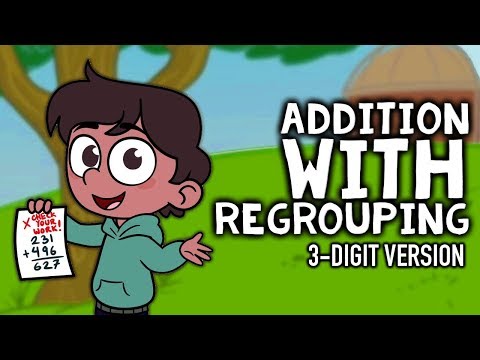
3 minPre-KK3-Digit Addition with Regrouping Song
NUMBEROCK
3 min2nd3-Digit Addition with Regrouping Song (Carrying)
NUMBEROCK
3 min2nd3rd3D Shapes Song
NUMBEROCK
4 minK1st3D Shapes Song (Solid Figures)
NUMBEROCK
2 minK1st5 Times Table Song
NUMBEROCK
4 min3rd6 Times Table Song
NUMBEROCK
3 min3rd4th6 Times Table Song (Skip Counting)
NUMBEROCK
2 min3rd4th7 Times Table Song
NUMBEROCK
3 min3rd4th7 Times Table Song (Skip Counting)
NUMBEROCK
2 min3rd4th8 Times Table Song
NUMBEROCK
3 min3rd4th8 Times Table Song (Skip Counting)
NUMBEROCK
2 min3rd4th9 Times Table Song
NUMBEROCK
3 min3rd4th9 Times Table Song (Skip Counting)
NUMBEROCK
3 min3rd4th11 Times Table Song
NUMBEROCK
3 min3rd4th12 Times Table Song
NUMBEROCK
3 min3rd4thAdd and Subtract Fractions with Like Denominators Song
NUMBEROCK
4 min3rd4thAdding and Subtracting by 10 and 100 Song
NUMBEROCK
3 min2ndAdding and Subtracting Decimals Song
NUMBEROCK
3 min4th5thAdding and Subtracting Fractions Song
NUMBEROCK
3 min4th5thAdding Mixed Numbers Song
NUMBEROCK
4 min4th5thAddition and Subtraction Number Sentences Song
NUMBEROCK
2 min1st2nd






Or use the filters above to narrow this down.