Series
Numberjacks
65 episodes
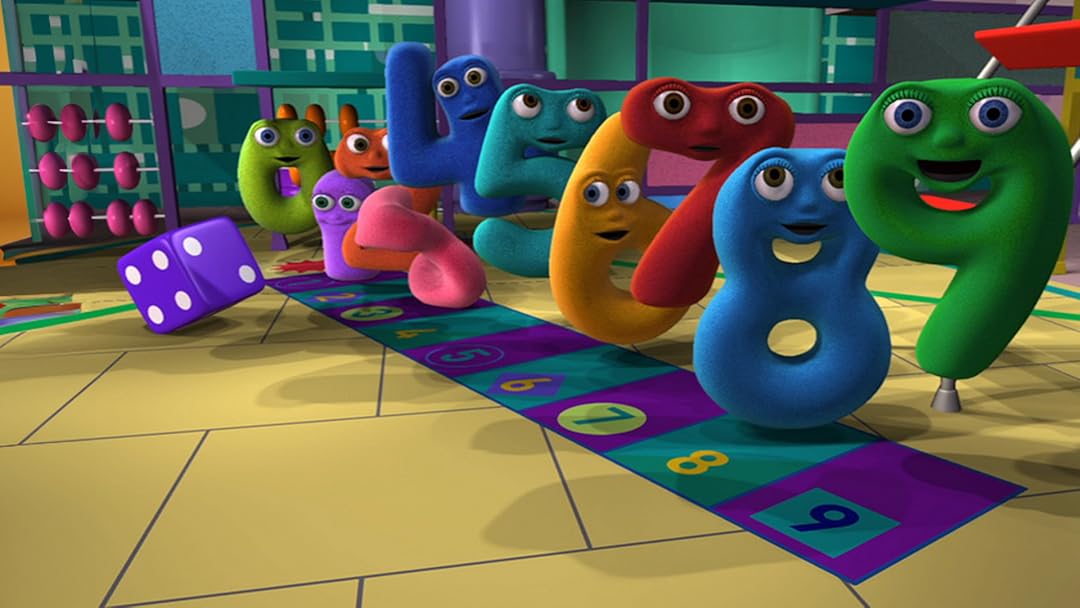
The Numberjacks are numbers who live behind the sofa and leap out whenever a maths problem needs fixing. Each of these full CBeebies episodes runs about fourteen minutes and hangs on a single idea: cylinders, splitting into halves, sorting when the rule changes, recording data on a chart, the number 3 and its triangles, near and far and next to. The BBC origin shows in the vocabulary, in 'maths' and the occasional British turn of phrase, but the number sense underneath is exactly what a K-2 class is working on. Best as the anchor of a numeracy warm-up or a maths centre.
What Numberjacks covers
65 episodes in the library, tagged for Pre-K–3rd. Heaviest coverage: Math. Between them they line up with 46 distinct standards across 2 frameworks.
Episodes per grade
- Pre-K
- 28
- K
- 48
- 1st
- 35
- 2nd
- 17
- 3rd
- 4
Episodes per subject
- Math
- 65
Common Core — Math 44
- K.CC.A.2Count forward beginning from a given number within the known sequence (instead of having to begin at 1).
- K.OA.A.3Decompose numbers less than or equal to 10 into pairs in more than one way, and record each decomposition by a drawing or equation.
- K.G.B.4Analyze and compare two- and three-dimensional shapes, in different sizes and orientations, using informal language to describe their similarities, differences, and parts.
- K.G.A.1Describe objects in the environment using names of shapes, and describe the relative positions of these objects using terms such as above, below, beside, in front of, behind, and next to.
- K.G.A.2Correctly name shapes regardless of their orientations or overall size.
- 1.OA.A.1Use addition and subtraction within 20 to solve word problems involving situations of adding to, taking from, putting together, taking apart, and comparing.
+ 38 more
- K.CC.B.4Understand the relationship between numbers and quantities; connect counting to cardinality.
- K.CC.B.5Count to answer "how many?" questions about as many as 20 things arranged in a line, array, or circle, or as many as 10 things in a scattered configuration.
- K.MD.B.3Classify objects into given categories; count the numbers of objects in each category and sort the categories by count.
- K.OA.A.4For any number from 1 to 9, find the number that makes 10 when added to the given number.
- 1.G.A.3Partition circles and rectangles into two and four equal shares, describe the shares using the words halves, fourths, and quarters.
- K.CC.A.1Count to 100 by ones and by tens.
- K.G.A.3Identify shapes as two-dimensional (lying in a plane, "flat") or three-dimensional ("solid").
- K.MD.A.1Describe measurable attributes of objects, such as length or weight; describe several measurable attributes of a single object.
- 1.MD.B.3Tell and write time in hours and half-hours using analog and digital clocks.
- 1.MD.C.4Organize, represent, and interpret data with up to three categories; ask and answer questions about the total number of data points.
- 1.OA.B.3Apply properties of operations as strategies to add and subtract (commutative and associative properties).
- 2.G.A.3Partition circles and rectangles into two, three, or four equal shares; describe the shares using the words halves, thirds, half of, a third of, etc.
- 2.MD.D.10Draw a picture graph and a bar graph to represent a data set with up to four categories; solve simple put-together, take-apart, and compare problems using the information.
- K.MD.A.2Directly compare two objects with a measurable attribute in common, to see which object has "more of"/"less of" the attribute.
- K.NBT.A.1Compose and decompose numbers from 11 to 19 into ten ones and some further ones to understand that these numbers are composed of ten ones and one, two, three, … nine ones.
- K.OA.A.1Represent addition and subtraction with objects, fingers, mental images, drawings, sounds, acting out situations, verbal explanations, expressions, or equations.
- K.OA.A.2Solve addition and subtraction word problems, and add and subtract within 10, using objects or drawings to represent the problem.
- 1.MD.A.1Order three objects by length; compare the lengths of two objects indirectly by using a third object.
- 1.MD.A.2Express the length of an object as a whole number of length units, by laying multiple copies of a shorter object end to end.
- 1.NBT.B.2Understand that the two digits of a two-digit number represent amounts of tens and ones.
- 1.NBT.B.3Compare two two-digit numbers based on meanings of the tens and ones digits, recording the results with the symbols >, =, and <.
- 1.NBT.C.5Given a two-digit number, mentally find 10 more or 10 less than the number, without having to count.
- 1.OA.C.5Relate counting to addition and subtraction (e.g., by counting on 2 to add 2).
- 1.OA.C.6Add and subtract within 20, demonstrating fluency for addition and subtraction within 10.
- 2.MD.A.3Estimate lengths using units of inches, feet, centimeters, and meters.
- 2.MD.C.7Tell and write time from analog and digital clocks to the nearest five minutes, using a.m. and p.m.
- 2.NBT.A.1Understand that the three digits of a three-digit number represent amounts of hundreds, tens, and ones.
- 2.NBT.A.2Count within 1000; skip-count by 5s, 10s, and 100s.
- 2.NBT.A.3Read and write numbers to 1000 using base-ten numerals, number names, and expanded form.
- 2.OA.C.3Determine whether a group of objects (up to 20) has an odd or even number of members.
- 2.OA.C.4Use addition to find the total number of objects arranged in rectangular arrays with up to 5 rows and up to 5 columns; write an equation to express the total.
- 3.MD.C.5Recognize area as an attribute of plane figures and understand concepts of area measurement.
- 3.MD.C.6Measure areas by counting unit squares (square cm, square m, square in, square ft, and improvised units).
- 3.NF.A.1Understand a fraction 1/b as the quantity formed by 1 part when a whole is partitioned into b equal parts; understand a fraction a/b as the quantity formed by a parts of size 1/b.
- 4.G.A.3Recognize a line of symmetry for a two-dimensional figure; identify line-symmetric figures and draw lines of symmetry.
- 4.OA.C.5Generate a number or shape pattern that follows a given rule; identify apparent features of the pattern that were not explicit in the rule itself.
- K.CC.A.3Write numbers from 0 to 20. Represent a number of objects with a written numeral 0–20 (with 0 representing a count of no objects).
- K.CC.C.6Identify whether the number of objects in one group is greater than, less than, or equal to the number of objects in another group.
Common Core — Math Practices 2
- MP1Make sense of problems and persevere in solving them.
- MP2Reason abstractly and quantitatively.
Every episode is vetted and tagged before it goes in. Pick your state in the filters above to see your own state’s codes alongside these.
24 of 65 results
The Trouble with Nothing
Numberjacks · 2006
14 minPre-KK
Going Wrong, Going Long
Numberjacks · 2006
14 minPre-KK1stSphere Today, Gone Tomorrow
Numberjacks · 2006
14 minK1stIn, Out, Shake It All About
Numberjacks · 2006
14 minPre-KKOne More Time
Numberjacks · 2006
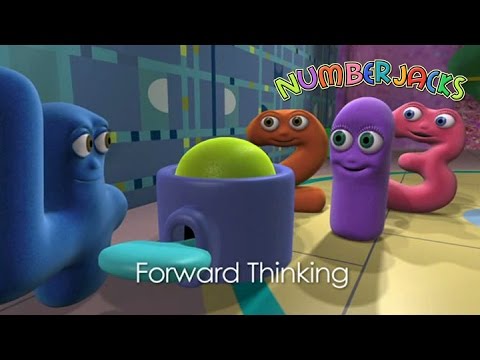
14 minPre-KKForward Thinking
Numberjacks · 2006
14 minPre-KKSeven Wonders
Numberjacks · 2006
14 minK1stGetting Heavy
Numberjacks · 2006
14 minPre-KK1stBelongings
Numberjacks · 2006
14 minPre-KK4, He's a Jolly Good Fellow
Numberjacks · 2006
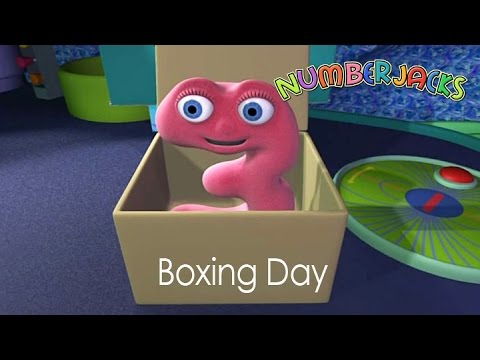
14 minPre-KKBoxing Day
Numberjacks · 2006
14 minK1stOut of Order
Numberjacks · 2006
14 minK1stNine Lives
Numberjacks · 2006
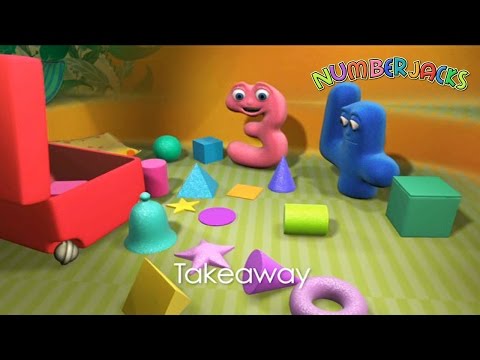
14 min2nd3rdTakeaway
Numberjacks · 2006
14 minK1stThe Cuck-Cuck-Cuck-Oo-Oo-Oo Bird
Numberjacks · 2006
14 minPre-KKStop and Go
Numberjacks · 2006
14 minPre-KKOff Colour
Numberjacks · 2006
14 minPre-KKA Game of Two Halves
Numberjacks · 2006
14 min1st2ndOut for the Count
Numberjacks · 2006
14 minPre-KKThe Container Drainer
Numberjacks · 2006
14 minPre-KKTens Moments
Numberjacks · 2006
14 minK1st3 Things Good
Numberjacks · 2006
14 minPre-KKSay What You Mean
Numberjacks · 2006
14 minK1stOne Won
Numberjacks · 2006
14 minK1st








Or use the filters above to narrow this down.