Series
Numberblocks
184 episodes
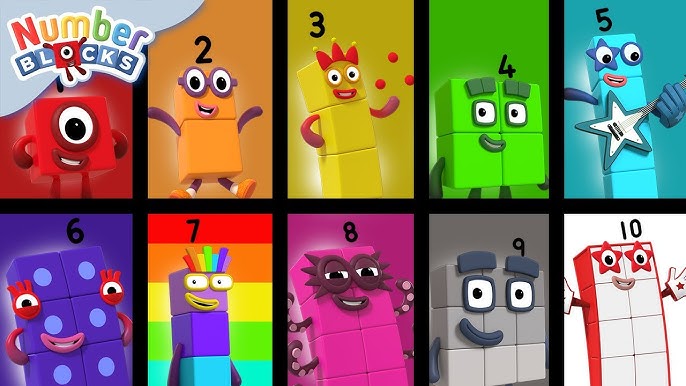
A British animated maths series where every number is a character built from that many blocks, so Five is literally five cubes and splitting Five apart is something you watch happen rather than something you are told. Episodes run about five minutes and hold to one idea: meeting a new number and counting its blocks, breaking a number apart and rebuilding it from smaller ones, counting equal groups toward a times table, balancing both sides of a bridge to show what equal means, comparing which is taller and which holds more. Number bonds and place value arrive as pictures long before they arrive as words.
What Numberblocks covers
184 episodes in the library, tagged for Pre-K–4th. Heaviest coverage: Math. Between them they line up with 45 distinct standards across 2 frameworks.
Episodes per grade
- Pre-K
- 21
- K
- 90
- 1st
- 93
- 2nd
- 60
- 3rd
- 60
- 4th
- 33
Episodes per subject
- Math
- 184
Common Core — Math 43
- 3.OA.A.1Interpret products of whole numbers, e.g., interpret 5 × 7 as the total number of objects in 5 groups of 7 objects each.
- 1.OA.C.6Add and subtract within 20, demonstrating fluency for addition and subtraction within 10.
- 3.OA.C.7Fluently multiply and divide within 100. By the end of Grade 3, know from memory all products of two one-digit numbers.
- 1.NBT.B.2Understand that the two digits of a two-digit number represent amounts of tens and ones.
- K.CC.B.4Understand the relationship between numbers and quantities; connect counting to cardinality.
- K.OA.A.2Solve addition and subtraction word problems, and add and subtract within 10, using objects or drawings to represent the problem.
+ 37 more
- 2.OA.C.4Use addition to find the total number of objects arranged in rectangular arrays with up to 5 rows and up to 5 columns; write an equation to express the total.
- K.CC.B.5Count to answer "how many?" questions about as many as 20 things arranged in a line, array, or circle, or as many as 10 things in a scattered configuration.
- K.OA.A.3Decompose numbers less than or equal to 10 into pairs in more than one way, and record each decomposition by a drawing or equation.
- K.OA.A.1Represent addition and subtraction with objects, fingers, mental images, drawings, sounds, acting out situations, verbal explanations, expressions, or equations.
- K.NBT.A.1Compose and decompose numbers from 11 to 19 into ten ones and some further ones to understand that these numbers are composed of ten ones and one, two, three, … nine ones.
- 1.NBT.A.1Count to 120, starting at any number less than 120. Read and write numerals and represent a number of objects with a written numeral.
- 3.OA.B.6Understand division as an unknown-factor problem.
- 2.OA.B.2Fluently add and subtract within 20 using mental strategies. Know from memory all sums of two one-digit numbers.
- 3.OA.A.2Interpret whole-number quotients of whole numbers, e.g., interpret 56 ÷ 8 as the number of objects in each share when 56 objects are partitioned equally into 8 shares.
- 2.NBT.A.1Understand that the three digits of a three-digit number represent amounts of hundreds, tens, and ones.
- 2.NBT.A.3Read and write numbers to 1000 using base-ten numerals, number names, and expanded form.
- K.CC.C.6Identify whether the number of objects in one group is greater than, less than, or equal to the number of objects in another group.
- 2.NBT.A.2Count within 1000; skip-count by 5s, 10s, and 100s.
- 1.NBT.B.3Compare two two-digit numbers based on meanings of the tens and ones digits, recording the results with the symbols >, =, and <.
- 2.OA.C.3Determine whether a group of objects (up to 20) has an odd or even number of members.
- 1.OA.A.1Use addition and subtraction within 20 to solve word problems involving situations of adding to, taking from, putting together, taking apart, and comparing.
- 1.OA.B.4Understand subtraction as an unknown-addend problem.
- 2.G.A.1Recognize and draw shapes having specified attributes, such as a given number of angles or a given number of equal faces; identify triangles, quadrilaterals, pentagons, hexagons, and cubes.
- 2.G.A.3Partition circles and rectangles into two, three, or four equal shares; describe the shares using the words halves, thirds, half of, a third of, etc.
- 3.NF.A.1Understand a fraction 1/b as the quantity formed by 1 part when a whole is partitioned into b equal parts; understand a fraction a/b as the quantity formed by a parts of size 1/b.
- 4.OA.C.5Generate a number or shape pattern that follows a given rule; identify apparent features of the pattern that were not explicit in the rule itself.
- K.G.A.2Correctly name shapes regardless of their orientations or overall size.
- K.G.B.4Analyze and compare two- and three-dimensional shapes, in different sizes and orientations, using informal language to describe their similarities, differences, and parts.
- K.MD.A.1Describe measurable attributes of objects, such as length or weight; describe several measurable attributes of a single object.
- K.MD.A.2Directly compare two objects with a measurable attribute in common, to see which object has "more of"/"less of" the attribute.
- 1.MD.B.3Tell and write time in hours and half-hours using analog and digital clocks.
- 1.MD.C.4Organize, represent, and interpret data with up to three categories; ask and answer questions about the total number of data points.
- 1.OA.C.5Relate counting to addition and subtraction (e.g., by counting on 2 to add 2).
- 1.OA.D.7Understand the meaning of the equal sign, and determine if equations involving addition and subtraction are true or false.
- 2.MD.C.7Tell and write time from analog and digital clocks to the nearest five minutes, using a.m. and p.m.
- 2.MD.D.10Draw a picture graph and a bar graph to represent a data set with up to four categories; solve simple put-together, take-apart, and compare problems using the information.
- 4.OA.B.4Find all factor pairs for a whole number in the range 1–100; recognize that a whole number is a multiple of each of its factors; determine whether a number is prime or composite.
- K.CC.A.1Count to 100 by ones and by tens.
- K.CC.A.2Count forward beginning from a given number within the known sequence (instead of having to begin at 1).
- K.CC.A.3Write numbers from 0 to 20. Represent a number of objects with a written numeral 0–20 (with 0 representing a count of no objects).
- K.G.A.1Describe objects in the environment using names of shapes, and describe the relative positions of these objects using terms such as above, below, beside, in front of, behind, and next to.
- K.OA.A.4For any number from 1 to 9, find the number that makes 10 when added to the given number.
Common Core — Math Practices 2
- MP7Look for and make use of structure.
- MP8Look for and express regularity in repeated reasoning.
Every episode is vetted and tagged before it goes in. Pick your state in the filters above to see your own state’s codes alongside these.
24 of 184 results
One
Numberblocks · 2017
5 minPre-KK
Another One
Numberblocks · 2017
5 minPre-KKTwo
Numberblocks · 2017
5 minPre-KKThree
Numberblocks · 2017
5 minPre-KKOne, Two, Three
Numberblocks · 2017
5 minPre-KKFour
Numberblocks · 2017
5 minPre-KKFive
Numberblocks · 2017
5 minPre-KKThree Little Pigs
Numberblocks · 2017
5 minPre-KKOff We Go
Numberblocks · 2017
5 minPre-KKHow to Count
Numberblocks · 2017
5 minPre-KKStampolines
Numberblocks · 2017
5 minPre-KKThe Whole of Me
Numberblocks · 2017
5 minK1stThe Terrible Twos
Numberblocks · 2017
5 minPre-KKHoles
Numberblocks · 2017
5 minK1stHide and Seek
Numberblocks · 2017
5 minK1stSix
Numberblocks · 2017
5 minPre-KKSeven
Numberblocks · 2017
5 minPre-KKEight
Numberblocks · 2017
5 minPre-KKNine
Numberblocks · 2017
5 minPre-KKTen
Numberblocks · 2017
5 minPre-KKJust Add One
Numberblocks · 2017
5 minK1stBlast Off
Numberblocks · 2017
5 minK1stCounting Sheep
Numberblocks · 2017
5 minK1stDouble Trouble
Numberblocks · 2017
5 min1st2nd




Or use the filters above to narrow this down.