Series
Math & Learning Videos 4 Kids
178 episodes
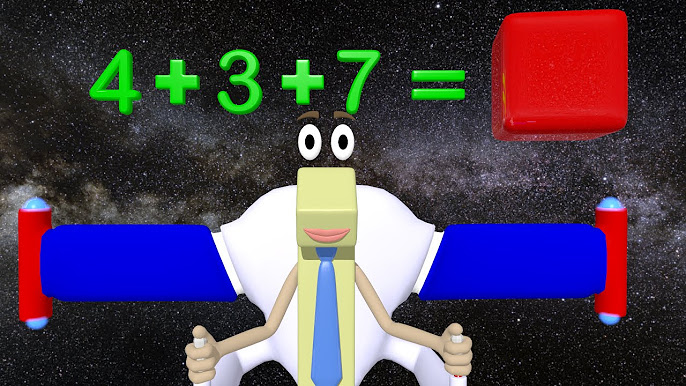
Also known as Mage Math, this channel teaches through bright 3-D animation with a worked example on screen for nearly every step. Coverage is grade-labeled and spans elementary maths end to end: counting within 120 on a hundred chart in grade 1, the commutative and associative properties, multi-digit addition staged in outer space, fractions with unlike denominators and mixed numbers in grades 4 and 5, decimals, and absolute value by grade 6. A handful of alphabet and read-along videos sit off to one side. Most run three to eleven minutes and are built to pause so kids can try the next step themselves.
What Math & Learning Videos 4 Kids covers
178 episodes in the library, tagged for Pre-K–6th. Heaviest coverage: Math, Reading & Writing (ELA) and Science. Between them they line up with 98 distinct standards across 4 frameworks.
Episodes per grade
- Pre-K
- 27
- K
- 35
- 1st
- 48
- 2nd
- 46
- 3rd
- 33
- 4th
- 21
- 5th
- 22
- 6th
- 14
Episodes per subject
- Math
- 147
- Reading & Writing (ELA)
- 19
- Science
- 7
- For Fun
- 3
- Social-Emotional Learning
- 2
NGSS (Science) 1
- 1-ESS1-1Use observations of the sun, moon, and stars to describe patterns that can be predicted.
Common Core — Math 89
- 2.NBT.B.7Add and subtract within 1000, using concrete models or drawings and strategies based on place value.
- 1.OA.A.1Use addition and subtraction within 20 to solve word problems involving situations of adding to, taking from, putting together, taking apart, and comparing.
- 1.NBT.B.2Understand that the two digits of a two-digit number represent amounts of tens and ones.
- 2.NBT.B.5Fluently add and subtract within 100 using strategies based on place value, properties of operations, and/or the relationship between addition and subtraction.
- K.CC.A.1Count to 100 by ones and by tens.
- K.CC.B.5Count to answer "how many?" questions about as many as 20 things arranged in a line, array, or circle, or as many as 10 things in a scattered configuration.
+ 83 more
- 1.MD.B.3Tell and write time in hours and half-hours using analog and digital clocks.
- 1.OA.B.4Understand subtraction as an unknown-addend problem.
- 2.MD.C.8Solve word problems involving dollar bills, quarters, dimes, nickels, and pennies, using $ and ¢ symbols appropriately.
- 2.NBT.A.1Understand that the three digits of a three-digit number represent amounts of hundreds, tens, and ones.
- 3.OA.C.7Fluently multiply and divide within 100. By the end of Grade 3, know from memory all products of two one-digit numbers.
- 5.NBT.B.7Add, subtract, multiply, and divide decimals to hundredths, using concrete models or drawings and strategies based on place value.
- 1.OA.C.6Add and subtract within 20, demonstrating fluency for addition and subtraction within 10.
- 2.NBT.A.2Count within 1000; skip-count by 5s, 10s, and 100s.
- 3.OA.B.5Apply properties of operations as strategies to multiply and divide (commutative, associative, and distributive properties).
- 4.NF.B.3Understand a fraction a/b with a > 1 as a sum of fractions 1/b; decompose a fraction into a sum of fractions with the same denominator; add and subtract mixed numbers.
- 6.RP.A.3Use ratio and rate reasoning to solve real-world and mathematical problems, e.g., by reasoning about tables of equivalent ratios, tape diagrams, double number lines, or equations.
- 1.NBT.A.1Count to 120, starting at any number less than 120. Read and write numerals and represent a number of objects with a written numeral.
- 1.NBT.B.3Compare two two-digit numbers based on meanings of the tens and ones digits, recording the results with the symbols >, =, and <.
- 1.OA.B.3Apply properties of operations as strategies to add and subtract (commutative and associative properties).
- 2.G.A.1Recognize and draw shapes having specified attributes, such as a given number of angles or a given number of equal faces; identify triangles, quadrilaterals, pentagons, hexagons, and cubes.
- 2.MD.D.10Draw a picture graph and a bar graph to represent a data set with up to four categories; solve simple put-together, take-apart, and compare problems using the information.
- 2.OA.C.3Determine whether a group of objects (up to 20) has an odd or even number of members.
- 3.MD.A.1Tell and write time to the nearest minute and measure time intervals in minutes; solve word problems involving addition and subtraction of time intervals.
- 3.NF.A.3Explain equivalence of fractions in special cases, and compare fractions by reasoning about their size.
- 3.OA.A.1Interpret products of whole numbers, e.g., interpret 5 × 7 as the total number of objects in 5 groups of 7 objects each.
- 3.OA.A.2Interpret whole-number quotients of whole numbers, e.g., interpret 56 ÷ 8 as the number of objects in each share when 56 objects are partitioned equally into 8 shares.
- 3.OA.B.6Understand division as an unknown-factor problem.
- 4.NBT.A.1Recognize that in a multi-digit whole number, a digit in one place represents ten times what it represents in the place to its right.
- 4.NBT.A.2Read and write multi-digit whole numbers using base-ten numerals, number names, and expanded form; compare two multi-digit numbers using >, =, and < symbols.
- 4.NBT.B.4Fluently add and subtract multi-digit whole numbers using the standard algorithm.
- 4.NBT.B.5Multiply a whole number of up to four digits by a one-digit whole number, and multiply two two-digit numbers, using strategies based on place value.
- 4.NBT.B.6Find whole-number quotients and remainders with up to four-digit dividends and one-digit divisors, using place value strategies and the relationship between multiplication and division.
- 5.NBT.A.1Recognize that in a multi-digit number, a digit in one place represents 10 times as much as it represents in the place to its right and 1/10 of what it represents in the place to its left.
- 5.NBT.A.2Explain patterns in the number of zeros of the product when multiplying a number by powers of 10, and in the placement of the decimal point; denote powers of 10 with exponents.
- 5.NBT.A.3Read, write, and compare decimals to thousandths using base-ten numerals, number names, expanded form, and >, =, < symbols.
- 5.NF.A.1Add and subtract fractions with unlike denominators (including mixed numbers) by replacing given fractions with equivalent fractions with a common denominator.
- 5.NF.B.3Interpret a fraction as division of the numerator by the denominator; solve word problems involving division of whole numbers leading to fraction or mixed-number answers.
- 5.OA.A.1Use parentheses, brackets, or braces in numerical expressions, and evaluate expressions with these symbols.
- 6.RP.A.2Understand the concept of a unit rate a/b associated with a ratio a:b with b ≠ 0, and use rate language in the context of a ratio relationship.
- K.G.A.2Correctly name shapes regardless of their orientations or overall size.
- 1.MD.A.1Order three objects by length; compare the lengths of two objects indirectly by using a third object.
- 1.MD.A.2Express the length of an object as a whole number of length units, by laying multiple copies of a shorter object end to end.
- 1.MD.C.4Organize, represent, and interpret data with up to three categories; ask and answer questions about the total number of data points.
- 1.NBT.C.4Add within 100, including adding a two-digit number and a one-digit number, and adding a two-digit number and a multiple of 10.
- 1.OA.A.2Solve word problems that call for addition of three whole numbers whose sum is less than or equal to 20.
- 1.OA.D.8Determine the unknown whole number in an addition or subtraction equation relating three whole numbers.
- 2.G.A.3Partition circles and rectangles into two, three, or four equal shares; describe the shares using the words halves, thirds, half of, a third of, etc.
- 2.MD.B.6Represent whole numbers as lengths from 0 on a number line diagram, and represent whole-number sums and differences within 100 on a number line.
- 2.MD.D.9Generate measurement data by measuring lengths of several objects, and show the measurements by making a line plot.
- 2.NBT.A.3Read and write numbers to 1000 using base-ten numerals, number names, and expanded form.
- 2.OA.A.1Use addition and subtraction within 100 to solve one- and two-step word problems involving situations of adding to, taking from, putting together, taking apart, and comparing.
- 3.MD.B.3Draw a scaled picture graph and a scaled bar graph to represent a data set with several categories; solve one- and two-step "how many more" and "how many less" problems.
- 3.MD.B.4Generate measurement data by measuring lengths using rulers marked with halves and fourths of an inch; show the data by making a line plot.
- 3.MD.C.5Recognize area as an attribute of plane figures and understand concepts of area measurement.
- 3.MD.C.6Measure areas by counting unit squares (square cm, square m, square in, square ft, and improvised units).
- 3.MD.D.8Solve real-world and mathematical problems involving perimeters of polygons, including finding an unknown side length.
- 3.NF.A.1Understand a fraction 1/b as the quantity formed by 1 part when a whole is partitioned into b equal parts; understand a fraction a/b as the quantity formed by a parts of size 1/b.
- 3.NF.A.2Understand a fraction as a number on the number line; represent fractions on a number line diagram.
- 3.OA.A.3Use multiplication and division within 100 to solve word problems in situations involving equal groups, arrays, and measurement quantities.
- 3.OA.A.4Determine the unknown whole number in a multiplication or division equation relating three whole numbers.
- 3.OA.D.8Solve two-step word problems using the four operations; represent these problems using equations with a letter standing for the unknown quantity.
- 4.NF.A.1Explain why a fraction a/b is equivalent to a fraction (n × a)/(n × b) by using visual fraction models; use this principle to recognize and generate equivalent fractions.
- 4.NF.A.2Compare two fractions with different numerators and different denominators by creating common denominators or numerators, or by comparing to a benchmark fraction.
- 4.NF.B.4Apply and extend previous understandings of multiplication to multiply a fraction by a whole number.
- 4.NF.C.6Use decimal notation for fractions with denominators 10 or 100.
- 4.NF.C.7Compare two decimals to hundredths by reasoning about their size; record the results of comparisons with the symbols >, =, or <.
- 4.OA.A.1Interpret a multiplication equation as a comparison; represent verbal statements of multiplicative comparisons as multiplication equations.
- 4.OA.A.2Multiply or divide to solve word problems involving multiplicative comparison, distinguishing multiplicative comparison from additive comparison.
- 4.OA.A.3Solve multistep word problems posed with whole numbers and having whole-number answers using the four operations, including problems with remainders.
- 4.OA.B.4Find all factor pairs for a whole number in the range 1–100; recognize that a whole number is a multiple of each of its factors; determine whether a number is prime or composite.
- 5.G.A.1Use a pair of perpendicular number lines (axes) to define a coordinate system; understand that the first number in an ordered pair indicates how far to travel along the x-axis.
- 5.MD.C.3Recognize volume as an attribute of solid figures and understand concepts of volume measurement using unit cubes.
- 5.MD.C.5Relate volume to the operations of multiplication and addition and solve real-world and mathematical problems involving volume.
- 5.NBT.B.5Fluently multiply multi-digit whole numbers using the standard algorithm.
- 5.NBT.B.6Find whole-number quotients of whole numbers with up to four-digit dividends and two-digit divisors, using strategies based on place value and the relationship between operations.
- 5.NF.B.4Apply and extend previous understandings of multiplication to multiply a fraction or whole number by a fraction.
- 5.NF.B.5Interpret multiplication as scaling (resizing) by comparing the size of a product to the size of one factor.
- 6.EE.A.2Write, read, and evaluate expressions in which letters stand for numbers.
- 6.EE.B.7Solve real-world and mathematical problems by writing and solving equations of the form x + p = q and px = q for cases in which p, q, and x are all nonnegative rational numbers.
- 6.EE.B.8Write an inequality of the form x > c or x < c to represent a constraint or condition in a real-world or mathematical problem; represent solutions on number line diagrams.
- 6.EE.C.9Use variables to represent two quantities in a real-world problem that change in relationship to one another; analyze the relationship using graphs and tables.
- 6.G.A.4Represent three-dimensional figures using nets made up of rectangles and triangles, and use the nets to find the surface area of these figures.
- 6.NS.A.1Interpret and compute quotients of fractions, and solve word problems involving division of fractions by fractions.
- 6.NS.C.7Understand ordering and absolute value of rational numbers.
- 6.RP.A.1Understand the concept of a ratio and use ratio language to describe a ratio relationship between two quantities.
- 6.SP.B.5Summarize numerical data sets in relation to their context, reporting the number of observations, measures of center, and measures of variability.
- K.CC.C.6Identify whether the number of objects in one group is greater than, less than, or equal to the number of objects in another group.
- K.OA.A.2Solve addition and subtraction word problems, and add and subtract within 10, using objects or drawings to represent the problem.
Common Core — ELA 4
- RF.K.1Demonstrate understanding of the organization and basic features of print.
- RF.K.3Know and apply grade-level phonics and word analysis skills in decoding words.
- RF.2.3Know and apply grade-level phonics and word analysis skills in decoding words.
- RF.1.3Know and apply grade-level phonics and word analysis skills in decoding words.
CASEL (Social-Emotional) 4
- CASEL.RS.2Build and keep positive relationships and friendships.
- CASEL.SM.1Manage strong emotions and impulses instead of acting on them right away.
- CASEL.SM.2Use calming and stress-management strategies (deep breaths, a break, asking for space).
- CASEL.SOA.2Demonstrate empathy and compassion for others.
Every episode is vetted and tagged before it goes in. Pick your state in the filters above to see your own state’s codes alongside these.
24 of 178 results
Learn Magnitude and Estimating - 1st Grade
Math & Learning Videos 4 Kids
4 min1st
Counting to 120 - First Grade Math Videos for Kids
Math & Learning Videos 4 Kids
4 min1stLearning Numbers for Kids with Number Eel - Counting for Kids Video 1 to 20
Math & Learning Videos 4 Kids
3 minPre-KKCounting from 10 to 20 Underwater Adventure
Math & Learning Videos 4 Kids
2 minPre-KKCounting by Tens - 10 to 100 with blocks train
Math & Learning Videos 4 Kids
2 min1st2ndComparing Numbers 1st Grade - Beware Alligators!
Math & Learning Videos 4 Kids
5 min1st120 Chart for 1st Grade - Counting within 120 with our Robot Friend
Math & Learning Videos 4 Kids
3 min1stCounting by 2's for Kids - Learn to Skip Count by Two with our Train
Math & Learning Videos 4 Kids
1 min1st2ndLearning Odd and Even Numbers for Kids - 1st and 2nd Grade
Math & Learning Videos 4 Kids
4 min2ndCounting to 10 Video for Kids - Counting to Ten Objects
Math & Learning Videos 4 Kids
2 minPre-KKLearning Numbers and Counting to Ten for Preschool and Kindergarten
Math & Learning Videos 4 Kids
5 minPre-KKMore and Fewer Kindergarten Math Video for Kids
Math & Learning Videos 4 Kids
3 minKSkip Counting by 2 and 5 - For 2nd Grade
Math & Learning Videos 4 Kids
4 min2ndComparing Numbers - Greater Than Less Than
Math & Learning Videos 4 Kids
5 min1stOdd and Even Numbers
Math & Learning Videos 4 Kids
3 min2ndLearning to Count to Ten in Space - Preschool and Kindergarten
Math & Learning Videos 4 Kids
2 minPre-KKLearn Place Value for 4th Grade: Up to the Millions Place!
Math & Learning Videos 4 Kids
11 min4thPowers of Ten Multiply and Divide 5th Grade
Math & Learning Videos 4 Kids
7 min5thPowers of Ten - 5th Grade
Math & Learning Videos 4 Kids
4 min5thTen Times Place Value - 4th Grade
Math & Learning Videos 4 Kids
4 min4thAddition within 100 Place Value Blocks Tens and Ones - 1st Grade Math Videos
Math & Learning Videos 4 Kids
5 min1stTeenage Numbers - Ten and Ones
Math & Learning Videos 4 Kids
3 min1stPlace Value First Grade - Tens and Ones
Math & Learning Videos 4 Kids
4 min1stPlace Value Grouping Video for 1st and 2nd Grade
Math & Learning Videos 4 Kids
6 min2nd




Or use the filters above to narrow this down.